

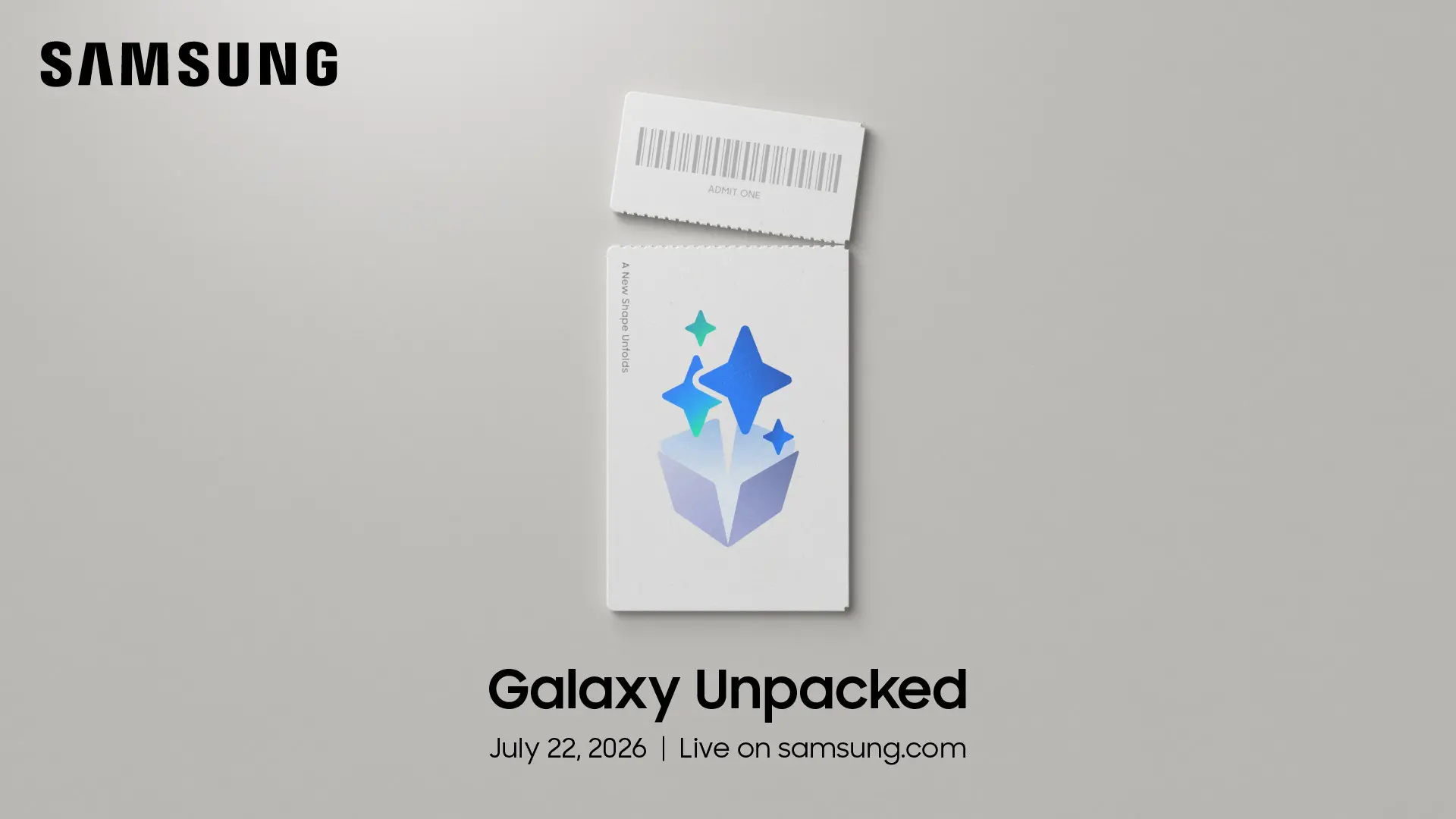
Samsung’s second Galaxy Unpacked event of the year is scheduled for July 22 in London, UK, and the event will be livestreamed on YouTube. We’ve come across innumerable leaks and early teasers of the devices that will be showcased at Unpacked, revealing practically everything we need to know.
However, given the number of devices Samsung is expected to launch next week, including that wide foldable we’ve all been looking forward to, things will look a bit different than the mid-year Galaxy Unpacked events of the past. With that in mind, here’s an in-depth look at what we expect to see from Samsung’s hardware launch event on Wednesday.
Galaxy Z Fold 8
The headliners at the event will be the Galaxy Z Fold 8 and its supposedly rebranded “Ultra” sibling. For the uninitiated, Samsung is expected to add the Ultra suffix to the Galaxy Z Fold 7 successor, while the wide version debuting this year will be called the Galaxy Z Fold 8. This marks a significant shift in Samsung’s foldable strategy, as the company aims to cater to different user preferences—those who want a more compact cover screen and those who prefer a traditional phone-sized external display.
According to rumors that have surfaced so far, the wide-body foldable will come equipped with a 5.5-inch, 120Hz Dynamic AMOLED 2X cover screen with a resolution of 1,972 x 1,248, and a foldable 7.6-inch, 120Hz Dynamic AMOLED 2X main display with a resolution of 2,448 x 1,848. The cover screen is notably wider than previous Z Fold models, offering a more conventional smartphone experience when folded. As leaked renders have shown so far, the Z Fold 8’s screen will have prominent borders, which some may find less modern but likely aids in durability.
Unlike the Z Fold models we’ve seen in the past, the Z Fold 8 will offer just two rear cameras: a 50MP, f/1.8 primary camera and a 50MP, f/1.9 ultrawide unit. Samsung is reportedly going to equip the device with 10MP selfie cameras on the primary display and the cover screen, respectively. This simplified camera setup may disappoint photography enthusiasts accustomed to telephoto lenses, but it aligns with the device’s positioning as a more affordable entry into the foldable market.
Qualcomm’s Snapdragon 8 Elite Gen 5 “for Galaxy” is said to be the chipset of choice, ensuring top-tier performance for gaming, multitasking, and AI tasks. A 4,800mAh battery could power the wide foldable, backed by 45W fast wired charging—an upgrade from previous generations that topped out at 25W. Given that the Galaxy Z Fold 8 technically sits a tier below the Ultra variant, it is expected to start from $1,899 in the US. Storage options of 256GB and 512GB are expected, both with 12GB of RAM, while the 1TB version could be paired with 16GB of RAM.
Galaxy Z Fold 8 Ultra
Despite the Ultra branding, this is the standard Z Fold model that we’ve seen for a few years now. Leaks suggest the Galaxy Z Fold 8 Ultra will retain a bulk of the predecessor’s elements, but with key hardware changes. You can expect to find a 6.5-inch, 120Hz Dynamic AMOLED 2X cover screen with a resolution of 2,520 x 1,080 on the device, and the 8-inch creaseless primary screen getting a resolution bump from the Galaxy Z Fold 7’s 2,184 x 1,968 to 2,504 x 2,256. The improved resolution should offer sharper text and images, especially useful for productivity tasks.
Other expected hardware specs include the Snapdragon 8 Elite Gen 5 “for Galaxy” and storage options of 256GB, 512GB, and 1TB. Much like the Galaxy Z Fold 8, the 1TB storage variant of the Ultra may get 16GB of RAM, while the two entry-level storage options could stick to 12GB. This ensures smooth performance for power users who run multiple apps simultaneously or use DeX mode extensively.
On the camera front, we’re likely going to see a 200MP, f/1.7 main sensor, a 10MP, f/2.4 3x telephoto unit, and a brand new 50MP, f/1.9 ultrawide camera, an upgrade from the Galaxy Z Fold 7’s 12MP, f/2.4 ultrawide sensor. This triple-camera setup is a significant sell for photographers, offering versatility from ultra-wide to 3x optical zoom. Prospective buyers should also be able to find the same two 10MP, f/2.2 selfie cameras on the primary and cover displays as the last-generation model.
If recent reports are accurate, the Galaxy Z Fold 8 Ultra could see a price bump, with the foldable expected to start from $2,099 this year. This increase likely reflects the enhanced cameras, larger displays, and the new chipset, but may test consumer willingness to pay a premium for foldable technology.
Galaxy Z Flip 8
While there’s plenty to look forward to with Samsung’s foldables this year, the Flip variant may not have as much to offer as its peers. A recent leak suggests that Samsung may not bring any significant upgrades to most of the Z Flip 8’s hardware, mainly just giving the phone a new chipset onboard. This incremental approach could disappoint fans hoping for a larger cover screen or improved cameras, but it may also keep the device more affordable.
Based on this, we may continue to see the 6.9-inch, 120Hz Dynamic AMOLED 2x primary display, paired with a 4.1-inch outer screen. The outer screen remains useful for quick interactions like notifications, music controls, and widgets. In the camera department, we’re expecting the same combination of a 50MP wide and 12MP ultrawide sensors on the back, with a 10MP selfie camera. This setup, while not groundbreaking, has proven capable for most social media and casual photography.
US customers will likely find the Snapdragon 8 Elite Gen 5 chip on the Z Flip 8, while the Exynos 2600 could power the foldable in other parts of the world. Samsung could offer the phone in 256 and 512GB storage options, both featuring 12GB of RAM. There’s also going to be a price bump this year, though the exact quantum of the increase isn’t clear. Leaked pricing suggests the phone could start at €1,299 (~$1,485) in Europe. For reference, last year’s Galaxy Z Flip 7 started from $1,099. This price hike may be harder to justify given the lack of major upgrades.
Galaxy Watch 9 series and Galaxy Watch Ultra 2
As with the new line of foldables, the Galaxy Watch 9 series has appeared frequently in leaks, while a recent teaser revealed some of the potential health upgrades the watches could feature. Going by recent reports, the wearable will be available in 40mm and 44mm trims, with the former featuring an unchanged 438 x 438 display. Meanwhile, the 44mm version will come equipped with a 480 x 480 screen. Samsung will also offer 2GB of RAM and 32/64GB of storage depending on the model, allowing for more apps and offline music storage.
The 40mm Galaxy Watch 9 variant may stick with a 325mAh battery pack, while the 44mm model could use a 445mAh battery onboard. Samsung is supposedly switching to Qualcomm’s Snapdragon Wear Elite SW6100 chip across all smartwatches launching this year, replacing the Exynos W1000 chip found in the Galaxy Watch 8 and the first-gen Watch Ultra. This change could bring better efficiency and performance, especially for health tracking and GPS.
Leaked prices for the Galaxy Watch 9 series from Europe suggest the 40mm Bluetooth-only Galaxy Watch 9 will start from €409 (~$470) and the LTE model could retail for €459 (~$525). The 44mm Galaxy Watch 9 could have a starting price tag of €439 (~$502), while the LTE variant may go up to €489 (~$560). These prices are slightly higher than the Watch 8 series, but competitive with rivals like the Apple Watch Series 9.
On the other hand, the Galaxy Watch Ultra 2 (47mm) will feature the predecessor’s 480 x 480 display, supposedly with up to 5,000 nits of peak brightness, an upgrade over the first-gen variant’s 3000 nits. This makes it much more usable in direct sunlight, a key advantage for outdoor athletes. Unsurprisingly, this smartwatch is also likely to be powered by the Snapdragon Wear Elite SW6100 SoC, moving away from the Exynos W1000 chip. It will continue to offer water resistance up to 100 meters, with the manufacturer also reportedly using more titanium in the casing this time around.
We are expecting an 800mAh battery pack on the Galaxy Watch Ultra 2, up from the first-gen model’s 590mAh unit. Customers may have to shell out €749 for the smartwatch in Europe, which translates to roughly $860 in the US. The final price may differ, as direct currency conversions don’t always hold up. All three smartwatches could run One UI 9 Watch out of the box, which is based on Wear OS 7.
One UI 9
As with most Unpacked events, Samsung is expected to share some key details on its next major software upgrade. While the Galaxy Z Fold 8, Z Fold 8 Ultra, and the Z Flip 8 could well feature the Android 17-based One UI 9 software out of the box, the company could also share information on existing flagships such as the Galaxy S26 series, Galaxy Z Fold 7/Z Flip 7, Galaxy S25 series, and others. This ensures that even users who aren’t buying new hardware can look forward to fresh features.
We’ve already caught multiple early glimpses of what One UI 9 could bring to Galaxy devices, including a customizable Quick Settings panel and minor tweaks to the status bar. Some improvements to the camera are also inbound, including the freshly discovered FanCam feature for videos, which allows users to record from multiple angles simultaneously. The upcoming software will also let you block internet access for select apps to improve your focus, a feature that almost everybody needs right now. Additionally, Samsung may introduce enhanced AI tools for photo editing, text summarization, and battery management.
One UI 9 is expected to build on the design language of One UI 8, with smoother animations, better multitasking, and deeper integration with Samsung’s ecosystem devices like tablets and PCs. The update could also bring improved privacy controls and a more intuitive settings menu.
What else can we expect?
We recently got a good look at Samsung’s answer to the Ray-Ban Meta glasses, known as the Galaxy Glasses (codenamed Jinju). Separate leaks have teased what some of its common gestures will look like, and revealed that it could run One UI XR, Samsung’s version of Android XR. These glasses are designed for augmented reality experiences, such as navigation overlays, hands-free notifications, and camera capture.
While we can’t independently confirm that the Galaxy Glasses will be showcased at next week’s Unpacked event, there’s a small chance that the company will share a sneak peek or preview of the smart glasses. Given the growing interest in AR wearables, a teaser would generate buzz even if a full launch isn’t imminent.
We’re unlikely to see any other hardware at this year’s July Unpacked event, unless Samsung has a big surprise in store. Although we’ve seen the Galaxy Buds Able/On appear in certification databases before, it’s not certain to be revealed next Wednesday. Meanwhile, the company launched the Galaxy Buds 4 series earlier this year, so they’re not due for an upgrade just yet. However, Samsung could introduce new colors or a special edition of existing buds.
In any case, Samsung has a lot to showcase at this year’s Unpacked, and you can catch all the action in the livestream on July 22, starting at 2 PM in London. People in the US can tune in at 9 AM Eastern or 6 AM Pacific time. The event will likely set the tone for the second half of 2026 in the mobile and wearable space, especially as competition from Google, Apple, and Chinese manufacturers heats up.
Source:Android Authority News