

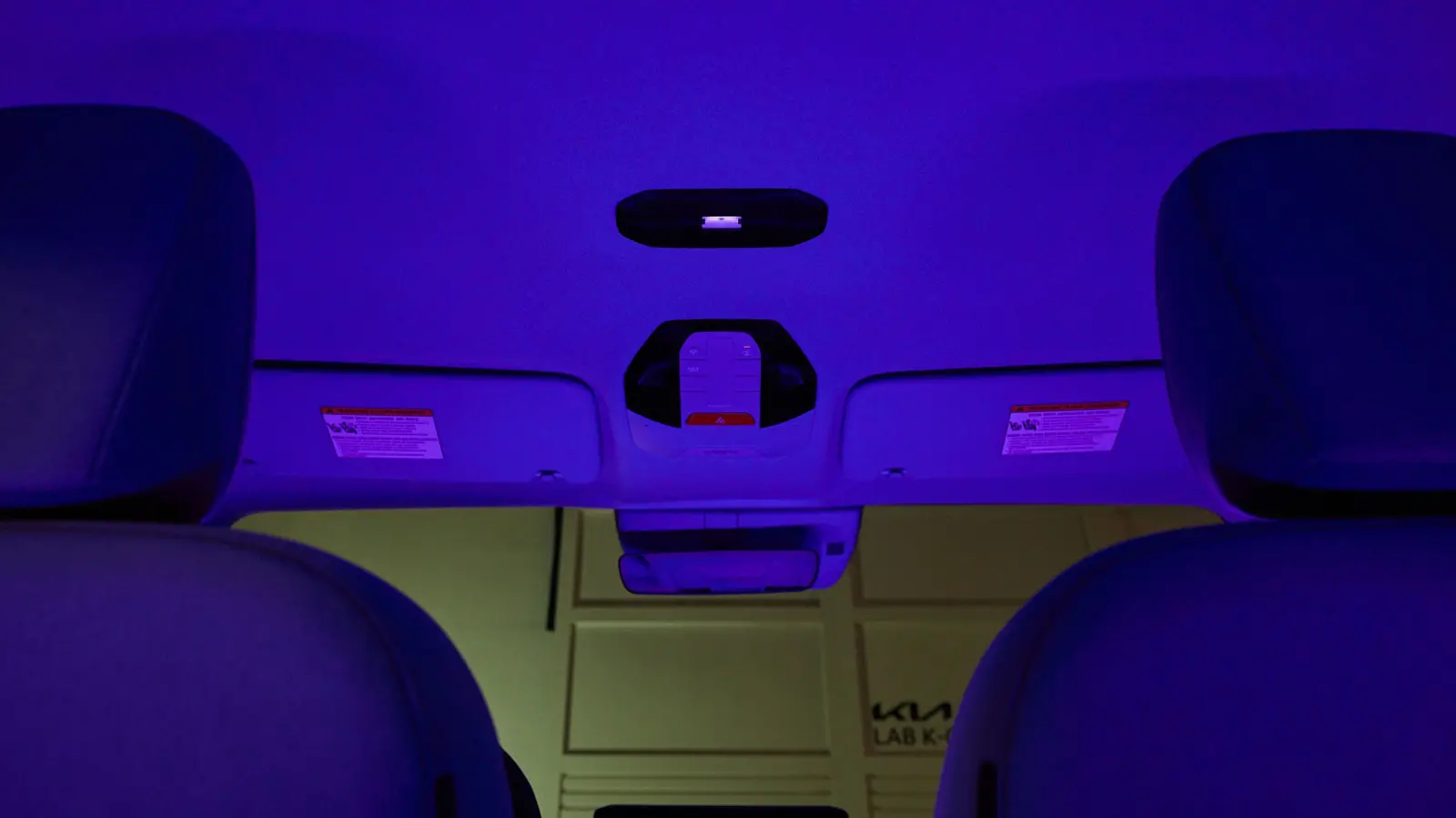
For most owners, keeping a vehicle ultra-clean isn't an easy task. Nonetheless, the health benefits of having a car that's free from germs are inarguable. Hyundai and Kia just unveiled new technology that aims to help make eliminating those germs a lot easier. The carmaker is calling the technology "Plasma Care UVC," and it uses far-ultraviolet C light with a wavelength of about 200-230 nanometers to sterilize a car's cabin. UV sterilization devices are not new, but traditionally, some use UV light of a slightly longer wavelength than Hyundai's new system. As a result, they have the potential to cause skin and eye damage if a human is exposed to them.
Hyundai says the far-UVC light it is using in its new technology won't cause damage, since the light doesn't penetrate human skin. However, it does still penetrate into bacteria and viruses, making it an effective way to sanitize a car even when the driver and passengers are present. Although this is the first time that far-UVC light sanitizers have been fitted to a vehicle cabin, similar systems that use the same wavelength of light are already used to clean rooms in healthcare settings like hospitals, as well as sanitizing hotels and classrooms.
The Science Behind Far-UVC Light
To understand why Hyundai's approach is both safe and effective, it helps to know a little about ultraviolet light. UV light is divided into three categories based on wavelength: UVA (315-400 nm), UVB (280-315 nm), and UVC (100-280 nm). UVC is the most energetic and is commonly used for germicidal irradiation because it disrupts the DNA and RNA of microorganisms, preventing them from replicating. However, conventional UVC light (254 nm) can also damage human cells, causing skin burns and eye injuries. Far-UVC, a subset of UVC with wavelengths around 200-230 nm, has a very limited penetration depth in biological tissues. Studies have shown that far-UVC light cannot reach living cells in human skin or eyes because it is absorbed by the outer layer of dead skin cells or the tear film on the eyes. This makes it safe for continuous exposure while still being highly effective against pathogens.
Research published in journals such as Nature and Photochemistry and Photobiology has demonstrated that far-UVC light can inactivate airborne influenza viruses, coronaviruses, and drug-resistant bacteria without harming mammalian skin. In 2020, Columbia University researchers tested far-UVC lamps in public spaces and found they reduced virus levels by over 99%. Hyundai's adoption of this technology for automotive use builds on that scientific foundation, adapting it to the unique constraints of a vehicle interior.
Engineering Challenges and Miniaturization
Hyundai says that its engineers encountered several challenges when trying to make the system work in cars, with one of the biggest being that the existing systems were simply too big to fit. Its team had to develop a new, miniaturized version of the system, as well as fitting an optical filter to ensure that no UV light of a harmful wavelength was emitted. The miniaturization involved compacting the lamp housing, driver electronics, and cooling components into a module small enough to be mounted inconspicuously in the roof liner, dashboard, or door panels. Additionally, the optical filter is critical: it blocks any stray UV radiation outside the 200-230 nm range, particularly the 254 nm wavelength, which could be harmful. The filter material itself had to be robust against UV degradation while maintaining high transmission for the desired band.
The team also had to account for the fact that car interiors are complex environments with shadows and varying distances to surfaces. They designed multiple lamps positioned strategically to ensure coverage of all common touchpoints: steering wheels, seats, door handles, cup holders, and armrests. Air circulation was another factor: Hyundai integrated the system with the vehicle's HVAC to draw cabin air over the UV lamps, continuously sterilizing airborne pathogens. This hybrid approach ensures that both surface and air sanitization are achieved.
Testing and Planned Applications
To test that the system worked as intended, the carmaker fitted it to a PV5 minivan. This model in particular was picked because it can be used for a range of different transport jobs, shuttling both passengers and cargo to their destinations. The PV5 is part of Hyundai's Platform Beyond Vehicle (PBV) strategy, a lineup of modular electric vehicles that can be configured for specific commercial roles. The testing included controlled laboratory evaluations where surfaces deliberately contaminated with bacteria were placed in the cabin, and UV exposure times were varied to determine the kill rate. Hyundai reported a 99.9% reduction in bacterial colonies after just 10 minutes of treatment.
Following the initial successful tests, Hyundai said that its technology could potentially be applied to autonomous vehicles and PBVs, a term that it has previously used to describe its modular electric vehicles that can be designed for a specific job. It gave the examples of school minibuses and food selling vehicles as two instances where sanitizing technology might be especially useful. For autonomous shuttles that operate without a driver, regular manual cleaning is impractical, so an automated UV system ensures consistent hygiene. Food trucks and vending vehicles could also benefit by keeping preparation surfaces sterile between uses.
Market Context and Consumer Demand
The pandemic has permanently raised consumer awareness about hygiene, and the automotive industry has responded with various clean-tech features. Several automakers now offer ionizers, hydrogen peroxide vaporizers, and ceramic coatings with antimicrobial properties. However, these methods either require the cabin to be unoccupied or have limited efficacy against certain pathogens. Far-UVC offers a next-generation solution that operates continuously and safely. According to a 2024 consumer survey by J.D. Power, 68% of car buyers said they would pay extra for built-in sanitization features if they were proven effective and safe. Hyundai's timing may capitalize on that sentiment, especially as fleets and ride-sharing services seek to reassure passengers.
Moreover, the technology has implications beyond private cars. School buses, where children often touch shared surfaces, could dramatically reduce illness transmission. Paratransit vehicles and taxis that carry multiple passengers daily would also see reduced cross-contamination. Hyundai's focus on PBVs and autonomous vehicles suggests they are thinking of high-usage scenarios where sanitization is most critical.
Competitive Landscape and Future Outlook
Hyundai is not the only automaker exploring UV for cars. In 2021, General Motors filed a patent for an autono-UV cleaning system that uses lights inside the cabin to sanitize surfaces when the car is unoccupied. Bosch, a tier-one supplier, has demonstrated a UVC light module for steering wheels and door handles. However, these systems operate only when no humans are present because they use conventional 254 nm UVC. Hyundai's far-UVC approach is unique in allowing operation during occupancy, which provides continuous protection. The key differentiator is the safety profile, which could give Hyundai a first-mover advantage if regulatory approvals are obtained.
As appealing as the new technology might sound to germaphobes, it isn't available to the general public just yet. Hyundai has not given a timeframe for when the UV sanitizers might launch in its production vehicles, saying only that it needs to conduct more safety and technical validation tests before it gives them approval for production. The company is likely working with health authorities and regulatory bodies to establish standards for UV exposure in vehicles, similar to the guidelines that exist for hospitals. Additionally, the cost of the modules needs to be reduced to make them viable for mass-market vehicles. Analysts speculate that the system could first appear on premium models under the Genesis brand or on Kia's EV9, before trickling down to more affordable options.
Another area of development is integration with smart cabin sensors. Hyundai could equip its UV system with occupancy detection so that the intensity or beam direction adjusts when passengers are present, further enhancing safety. The system could also be linked to a car's infotainment screen, allowing drivers to schedule sanitization cycles remotely via a smartphone app. Over-the-air updates could refine the algorithms that determine optimal exposure times based on cabin temperature and humidity, which affect microorganism survival.
The potential benefits extend to environmental sustainability. By reducing the need for chemical cleaners and disposable wipes, UV sanitization cuts down on waste and chemical runoff. As automakers push toward zero-emission vehicles, onboard sanitization that relies only on electricity and a small lamp is a clean complement. Hyundai and Kia have also been developing antimicrobial surfaces made from silver ions or copper, which could be used in conjunction with far-UVC for a layered defense.
In summary, Hyundai and Kia's Plasma Care UVC represents a significant step forward in automotive hygiene. By harnessing the unique properties of far-UVC light, the system can continuously sanitize a car's cabin without endangering its occupants. The engineering challenges of miniaturization and optical filtering have been addressed, and real-world testing on the PV5 minivan has shown promising results. While commercial availability remains pending, the technology's potential for autonomous vehicles, ride-sharing, and commercial fleets is enormous. As consumer demand for health-conscious features grows, far-UVC could become a staple feature in future vehicles, transforming the way we think about cleanliness on the road.
Source:SlashGear News