

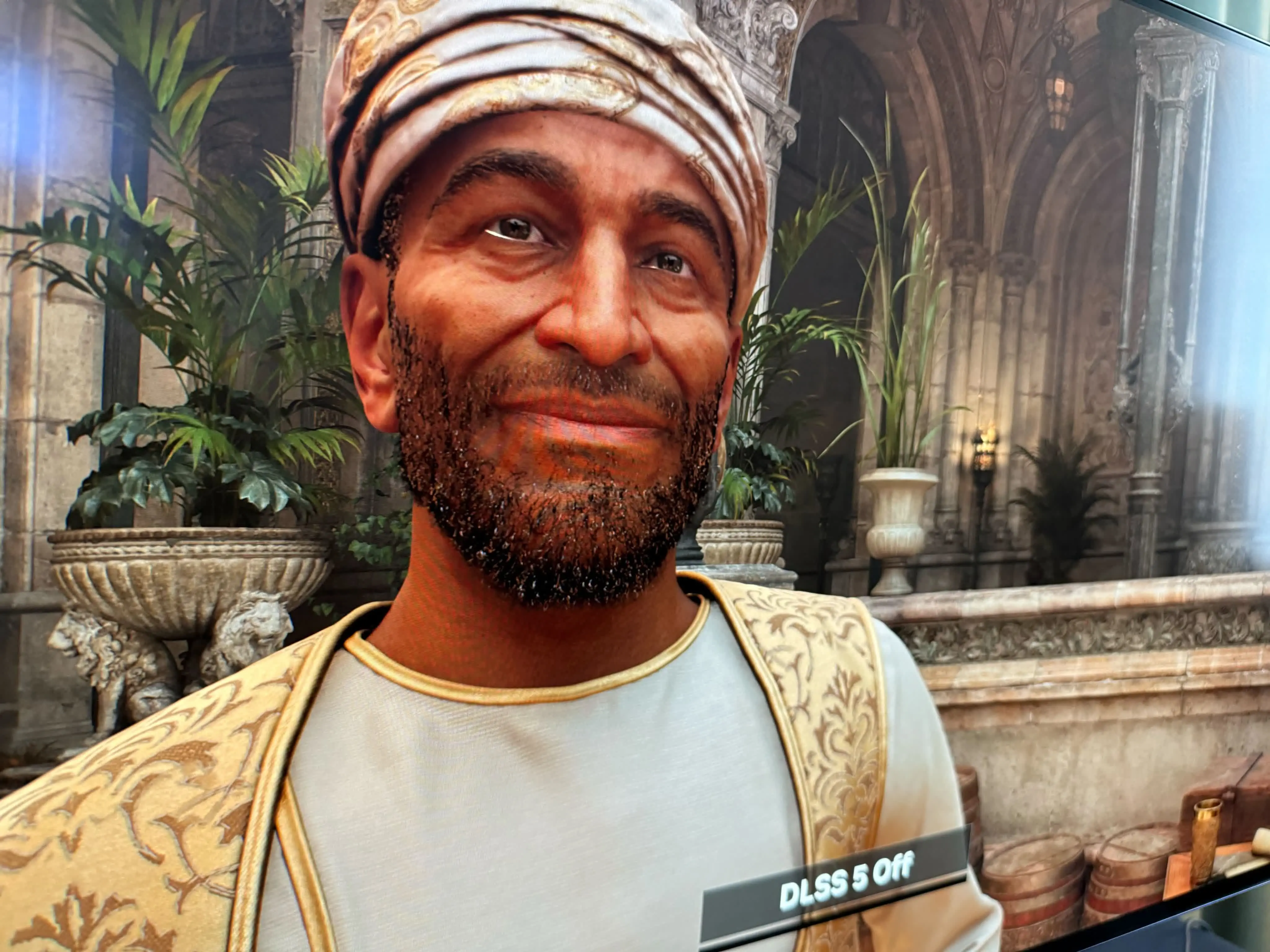
Nvidia's DLSS 5 has arrived, and the internet has already formed strong opinions. But those opinions may be missing the full picture. This article offers a detailed look from a hands-on experience at GTC 2026, where the technology was demonstrated across multiple titles in real time.
Why Faces Steal the Spotlight
For years, achieving photorealistic human faces in real-time games has been one of the most demanding challenges in computer graphics. Subsurface scattering, hair strand interaction, and micro-expressions require enormous computing resources. Many previous tech demos featured isolated floating heads because rendering a full body at that quality was simply too expensive.
DLSS 5 changes that. It brings facial rendering to a level that matches the photorealism already achieved in environments. This dramatic improvement naturally draws attention, but it's not the whole story.
Beyond Faces: Coffee Makers, Water, and Foliage
The hands-on demos revealed improvements across entire scenes. In Starfield, a simple coffee maker on a countertop transformed from a flat asset into an object with volume and natural lighting. In Oblivion Remastered, water achieved a level of realism that could pass for offline renders, with proper light interaction and shimmer. Assassin's Creed Shadows showed enhanced depth and light movement through tree canopies. The Zorah tech demo demonstrated subsurface scattering on foliage that matched the quality of facial rendering.
These improvements come from a single unified AI model. It analyzes the raw color buffer and motion vectors, identifies material types—skin, metal, water, stone, foliage—and applies specific lighting and material enhancements per object. This is not a filter; it's a fundamentally different approach to image assembly that remains consistent frame to frame.
Developer Control Ensures Artistic Intent
One crucial aspect is the level of control offered to developers. DLSS 5 does not force a one-size-fits-all enhancement. Developers can adjust intensity per material type using spatial masking—water at 100%, wood at 30%, characters at 120% within the same scene. Color grading controls for blending, contrast, saturation, and gamma are also available. This runs through the existing SDK, familiar to studios already using DLSS and Reflex.
Major studios including Bethesda, CAPCOM, Ubisoft, Tencent, and Warner Bros. Games have already signed on. Technical artists within these studios have reportedly become internal advocates for the technology because it helps them recover visual fidelity lost when dropping authoring-tool assets into real-time game engines with tight performance budgets.
Hardware Requirements and Multi-GPU Revival
The demonstrations were run on two RTX 5090 GPUs—one for game rendering, one dedicated to the DLSS 5 AI model. Nvidia acknowledges significant optimization work remains, with the target being single-GPU operation at launch in fall 2026. Interestingly, this revives the concept of multi-GPU gaming for a legitimate AI workload, after years of SLI and CrossFire being effectively dead.
Supported Games and Launch Timeline
First-wave titles include Starfield, Assassin's Creed Shadows, Resident Evil Requiem, Hogwarts Legacy, Phantom Blade Zero, Oblivion Remastered, Delta Force, and more. DLSS 5 works across rasterized, ray-traced, and path-traced rendering. The higher the input fidelity, the better the output.
As neural rendering matures, the technology represents a paradigm shift in how final images are assembled. The early social media narrative of a simple face filter does not hold up when the full scope of scene-wide improvements is observed—from coffee makers to stone textures to leaves in sunlight. The real story is in the comprehensive enhancement of every visual element.
Source:TechSpot News