

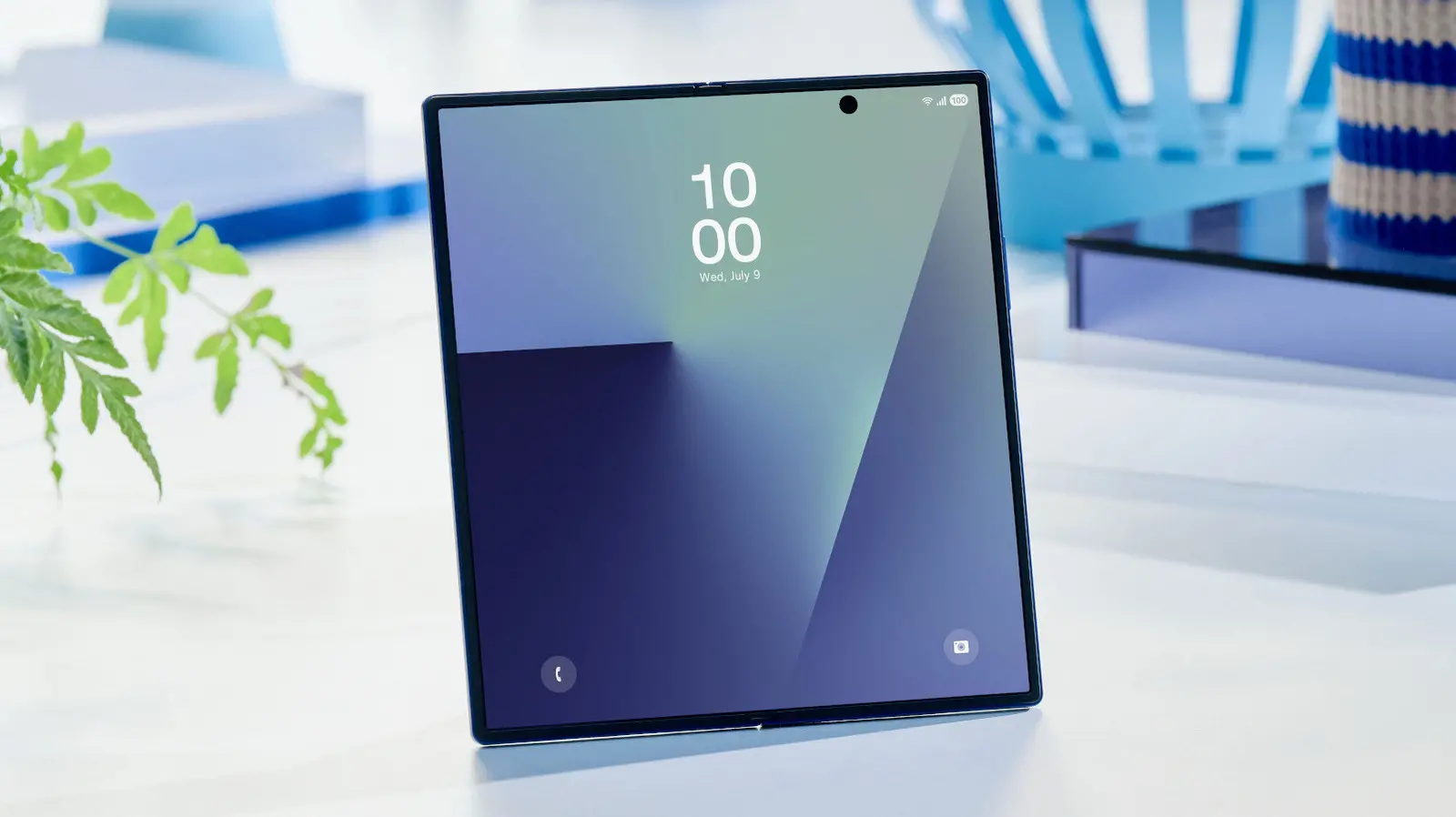
Samsung has introduced its new Flex Titanium display technology, which will debut with the next generation of Galaxy foldable devices. It features a new structure that uses material advancements to offer a more durable display with a less noticeable crease. The company says it was built on 'seven generations of foldable innovation and engineering expertise,' suggesting it will launch with the Galaxy Z Fold 8 and Flip 8. Samsung is expected to unveil the new foldables at its upcoming Unpacked event on July 22.
The company developed two components for the new display technology. One of them is a titanium alloy film that sits beneath the OLED panel, giving the display 20 times greater mechanical stiffness. Underneath that is a titanium plate, which provides stable support when the device is unfolded and retains the flexibility the phone needs to withstand repeated folding. The new titanium plate eliminates 'air gaps between the module and [its] adhesive through advanced hole processing technology.' Kyung-Jin Yoo, EVP for Samsung Display, said the 'micro-patterned holes' in the folding section of the titanium plate provide 'flexibility with robust durability.'
We only have a few days left before we can see for ourselves whether the next generation of Samsung devices truly have less visible folds. At CES earlier this year, however, we did see Samsung's 'seamless' foldable display exhibit, which showed a device with an invisible crease at the center. It made the Samsung phone with an older display tech, showcased beside it, look messy by comparison, with a very visible crease. 9to5Google also spotted a leaked video of what's purported to be the Galaxy Z Fold 8 Ultra, which shows a very smooth screen that has no visible crease.
Background: The Evolution of Foldable Displays
Samsung has been at the forefront of foldable smartphone technology since the launch of the original Galaxy Fold in 2019. That first generation featured a plastic display that was prone to scratches and had a pronounced crease down the center. Over subsequent years, the company refined its Ultra Thin Glass (UTG) panels, improved hinge mechanisms, and introduced water resistance. The Galaxy Z Fold 3 brought an under-display camera, while the Fold 4 and Fold 5 focused on durability and weight reduction. The Fold 6 and Fold 7 further enhanced the hinge and display layers to minimize the crease, but it never completely disappeared. With the Flex Titanium technology, Samsung aims to achieve that long-sought-after invisible fold.
The Science Behind Flex Titanium
The key innovation lies in the use of titanium—a material known for its high strength-to-weight ratio and corrosion resistance. The titanium alloy film below the OLED is just a few micrometers thick but provides 20 times the mechanical stiffness of previous support layers. This stiffness reduces the microscopic buckling that creates the crease when the display is folded. The titanium plate below that film is laser-cut with hundreds of tiny holes in the folding region, allowing the plate to bend without cracking while still offering firm support. These holes also eliminate trapped air, which previously caused visible distortions and uneven pressure on the OLED. The result is a display that not only looks flatter but also withstands more folding cycles—Samsung claims a lifespan of over 200,000 folds, equivalent to about 100 folds per day for five years.
Implications for the Galaxy Z Fold 8 and Flip 8
The Flex Titanium display is expected to be a core feature of the upcoming Galaxy Z Fold 8 and Z Flip 8. The Fold 8 is rumored to have a wider front cover display, a larger main screen, and a more powerful processor—likely the Exynos 2500 or Snapdragon 8 Gen 4 in select markets. The Flip 8 may see a battery capacity increase and a refined camera system. But the display technology will be the headline feature, as it directly addresses the biggest complaint among foldable users: the crease. A smooth, crease-free display could convince more consumers to switch from traditional slab phones to foldables. Samsung is also expected to use the same technology in its Galaxy Z Fold 8 Ultra model, which might have a thinner profile and a lighter weight thanks to the titanium components.
Industry Reactions and Comparisons
Competitors like Google, with its Pixel Fold, and OnePlus, with its Open series, have made strides in reducing crease visibility, but none have yet achieved an invisible fold. Huawei's Mate X series uses an outward-folding design that avoids a crease altogether, but that design leaves the screen exposed. Samsung's approach—keeping the foldable display protected inside the device while nearly eliminating the crease—could set a new benchmark. Tech analysts have responded positively to the leaked video, noting that if the production units match the prototype shown at CES, Samsung will leap ahead in the foldable market. Some experts also point out that the titanium materials could make the devices more expensive, but that premium may be justified by the improved durability and user experience.
What to Expect at Unpacked 2026
Samsung's next Unpacked event is scheduled for July 22, 2026, and will be held at the Seoul Olympic Stadium. In addition to the Galaxy Z Fold 8 and Flip 8, the company is expected to launch the Galaxy Watch 7 series, the Galaxy Buds 3 Pro, and possibly the Galaxy Ring. The event theme, 'Join the Fold Side,' suggests a strong focus on foldables. Samsung is also expected to showcase its One UI 7.1, which will include new multitasking features optimized for the larger foldable screens. The Flex Titanium display will be the star of the show, and early hands-on impressions will be crucial in determining whether Samsung has finally solved the crease problem.
The development of Flex Titanium also reflects Samsung's broader strategy to invest in premium materials. The company has been using titanium in its Galaxy S24 Ultra and Galaxy S25 Ultra frames, offering improved drop protection. Extending titanium to the display layer is a natural progression. Samsung Display, the subsidiary responsible for the panels, has been working on this technology for over three years, and its adoption in the foldable lineup signals a maturation of the foldable smartphone category. As the market for foldables grows—expected to reach 100 million units by 2028—Samsung aims to maintain its dominant position by offering the best display quality and durability.
Source:Engadget News