

The best gaming handhelds for 2026
Handheld gaming systems are no longer a niche product category. Today's devices range from compact retro-emulation machines to full portable PCs capable of running modern AAA games. That range is exciting, but it makes shopping harder. The best gaming handheld for any individual now depends less on a single benchmark and more on how, where and what that person wants to play.
Some handhelds are built for short sessions and classic libraries. They emphasize simplicity, long battery life and easy portability. Others blur the line between console and PC, adding large screens, powerful chips and access to massive game libraries in exchange for extra size, cost or reduced endurance. A few niche options even focus on unusual controls or deliberately limited experiences.
We've spent months testing and tracking the fast-moving sector to find out which devices are actually worth buying in early 2026. The list covers all-rounders, premium portable PCs, mobile emulation machines and game-specific hardware. If you need a quick answer: the Steam Deck OLED is the best all-around SteamOS handheld, the Lenovo Legion Go S (SteamOS) is the stronger premium alternative, the ASUS ROG Xbox Ally X is the best Windows-based option, and the Retroid Pocket 5 is our favorite low-cost emulation device.
If you want the absolute newest hardware, be aware that several more devices have been announced in recent months, including new variants of existing models and a wave of dual-screen emulation handhelds. We are still working to test most of those. The recommendations below remain the ones most people should buy right now.
Key facts at a glance
- Steam Deck OLED is the best overall gaming handheld PC for most players; the entry-level LCD Steam Deck is the best budget pick.
- Lenovo Legion Go S (SteamOS) offers significantly more power than the Steam Deck with a larger 120Hz VRR display, but it is heavy and expensive.
- ASUS ROG Xbox Ally X is the best Windows handheld for storefront flexibility and high frame rates in demanding games.
- Retroid Pocket 5 and Retroid Pocket Flip 2 are the best Android emulation handhelds for the price; AYN Odin 2 is a faster step up.
- Analogue Pocket remains the best option for playing authentic Game Boy cartridges.
- Nintendo Switch 2 is the handheld to buy for exclusive Nintendo games, but it is not a direct competitor to the portable PCs above.
How to choose a gaming handheld
The market can be split into three broad tiers. At the top are x86-based portable gaming PCs such as the Steam Deck, Lenovo Legion Go S and ROG Xbox Ally X. These are the most powerful handhelds you can buy, and they attempt to replicate a moderately specced gaming desktop. They can play modern PC games natively and emulate the widest range of retro consoles. They are also the largest, heaviest and most expensive devices in this guide, often costing between 400 and 1,000 dollars.
The second tier covers Android and Linux handhelds such as the Retroid Pocket 5 and AYN Odin 2. They are less powerful than portable PCs, and they cannot run Windows games without streaming. Their main appeal is a smaller body, lower price and enough processing power for emulating older PlayStation, Nintendo and Sega systems. Emulation setup can be complicated, and ROM legality is murky, but these devices remain the most practical way to play classic games outside of original hardware.
The final tier consists of handhelds that do their own thing: the Nintendo Switch 2, Analogue Pocket and Playdate are good examples. They run heavily customized software, target specific experiences and rarely try to match the flexibility of a PC. They often have distinct game libraries, making them easier to recommend to someone who does not want to tinker.
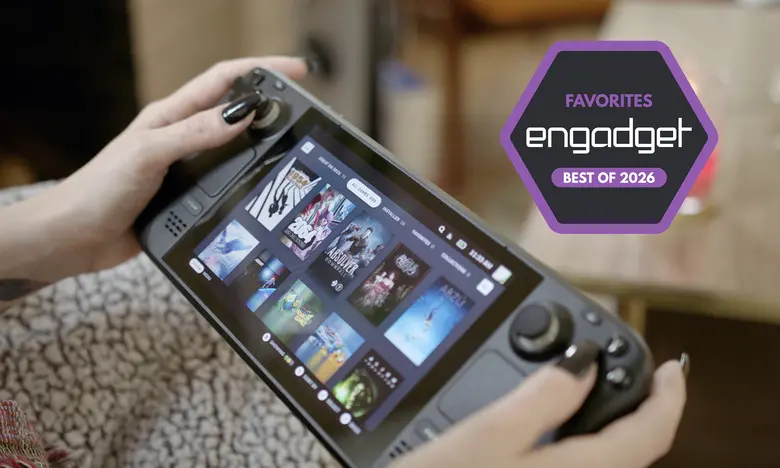
Best SteamOS handheld for most people: Steam Deck
The Steam Deck remains the best balance of price, performance and usability in the handheld PC space. The OLED version is a significant improvement over the original with a 7.4-inch HDR OLED display that is brighter, more vivid and slightly faster than the LCD panel. It supports a 90Hz refresh rate, which makes games look smoother in motion. The OLED model also has a larger battery, a more efficient chip and a bigger fan, so it tends to run longer, cooler and quieter than the older version.
The base Steam Deck is a different product. It uses a 7-inch LCD, a 40Whr battery and the older 15W AMD APU, but it costs only 399 dollars with 256GB of storage. For that price, it is still the best budget handheld gaming PC. It can play a huge selection of Steam games, from indie hits to demanding open-world titles, though the most graphically intensive releases of the last couple of years may require low settings or miss official support.
Valve's SteamOS has matured into a polished platform. It is not as pick-up-and-play as a console, but it is far easier to manage than Windows on a handheld. The biggest issue with the Deck is physical size. It is almost a foot long and two inches thick, which makes it awkward to carry in a bag. The LCD model can also get warm and loud under load. Still, the OLED version remains the handheld we recommend to most PC gamers.
Pros
- Plays a huge portion of the Steam library
- User-friendly SteamOS interface
- Vivid OLED display with HDR on the premium model
- Great emulation performance with community tools
- Entry model is a fantastic value
Cons
- Large and heavy
- Less powerful than newer competitors
- Does not officially support every game or other storefronts
Best premium SteamOS handheld: Lenovo Legion Go S (SteamOS, Z1 Extreme)
The Lenovo Legion Go S with SteamOS is the closest thing we have to a Steam Deck 2. It is one of the first third-party handhelds to run Valve's operating system natively, so it offers the same convenience and occasional compatibility quirks as the Steam Deck. The difference is that this device uses the more powerful AMD Ryzen Z1 Extreme chip, paired with 32GB of RAM and a 1TB SSD in the configuration we recommend. It can draw up to 33W in handheld mode or 40W when plugged in, which is far above the Steam Deck's 15W limit.
That extra headroom translates into noticeably higher frame rates in demanding games. Recent AAA titles that struggle on a Steam Deck can approach a smooth 60fps on the Legion Go S with the right settings. The device also has an 8-inch IPS display with a 1,920 x 1,200 resolution, a 120Hz refresh rate and variable refresh rate support. VRR is a huge advantage because it reduces screen tearing and makes frame rate drops less distracting.
The trade-offs are just as clear. The Legion Go S is heavier than the Steam Deck and only offers average battery life of about two hours under heavy gaming loads. It also lacks the deep contrast and HDR of the Steam Deck OLED. The premium model currently costs around 900 dollars, which is far more than Valve's handheld. A cheaper Legion Go S version with a Ryzen Z2 Go chip, 16GB RAM and 512GB storage is available for around 650 dollars, and it should still outperform a Steam Deck, but we have not yet tested that configuration.
Pros
- Stronger performance than the Steam Deck
- Runs official SteamOS
- Large, sharp display with VRR
- Comfortable grips and usable controls
Cons
- Expensive
- Heavier than Steam Deck
- No HDR
- Weak haptics and noisy fans under load
Best Windows handheld: ASUS ROG Xbox Ally X
The ASUS ROG Xbox Ally X is the Windows-based handheld we recommend to people who want maximum software flexibility. Microsoft markets it as a handheld Xbox, but it is really a fully functioning Windows 11 PC. That means it can run games from Steam, Epic, GOG, Xbox Game Pass and any other PC launcher without workarounds. It also ships with a full-screen Xbox experience that makes it easier to browse and launch games using a controller, though you may still occasionally drop into a traditional Windows desktop view.
The key advantage over the Steam Deck is performance. The Xbox Ally X uses an AMD Ryzen Z2 Extreme chip, 24GB of RAM and a 1TB SSD. In our testing, it handled demanding games far more consistently than Valve's handheld, especially when running at higher power limits. The 7-inch 1080p display runs at 120Hz and supports VRR, which helps games feel smooth even when their frame rates wobble. The battery is also a massive 80Whr, giving several more hours of life than most Windows handhelds.
The downsides are price and complexity. At 1,000 dollars, this is a luxury device. Windows 11 still has quirks on handhelds: some settings live outside the main Xbox interface, touch navigation can be awkward, and the preinstalled bloatware is unnecessary. The device is also heavy, and its haptics remain mediocre. But if you value PC game flexibility, the Xbox Ally X is the Windows handheld we would choose today.
Pros
- More powerful than the Steam Deck
- Runs any Windows game store
- 1080p 120Hz display with VRR
- Superb battery life for a Windows handheld
- Comfortable controller-style grips
Cons
- Very expensive
- Bulky
- Windows can still feel clunky
- Weak haptics
Best emulation handheld for most people: Retroid Pocket 5
The Retroid Pocket 5 is the device to buy if you want to emulate older consoles without spending PC-level money. It is an Android handheld powered by the Snapdragon 865 chip and 8GB of RAM, with a built-in fan for extra performance. It is not designed for modern PC games, but it excels at PlayStation 2, GameCube, PSP, Dreamcast, N64 and older systems.
In our testing, demanding PS2 games such as Gran Turismo 4 and Ratchet and Clank ran at full speed with upscaled resolution. GameCube classics like Super Mario Sunshine and F-Zero GX were also smooth. The 5.5-inch OLED display is vibrant and sharp, and the Hall effect joysticks should avoid drift over time. The active cooling system keeps things comfortable, although the fan is noisy at its highest setting.
Emulation on this device requires patience. You need to find ROMs, choose the correct emulator, map controls and sometimes alter individual game settings. A few tricky titles will still have glitches or performance problems. But if you enjoy tweaking old games more than fighting with a Windows PC, the Pocket 5 offers incredible value for its 219-dollar price.
Pros
- Excellent PS2 and GameCube performance for the price
- Lovely OLED display
- Solid controls and build quality
- Portable and comfortable enough for long sessions
Cons
- Requires a lot of emulator setup
- Left joystick placement is not ideal for modern games
Another good emulation option: Retroid Pocket Flip 2
The Retroid Pocket Flip 2 is essentially the Pocket 5 in a clamshell body. It has the same chipset, display, battery and software, so its emulation performance is identical. The clamshell design protects the screen and makes it easy to throw into a bag, but it adds weight and thickness. The joysticks are recessed into the bottom half, which makes them feel slightly awkward compared with the Pocket 5. Still, if you prefer the look and protection of a folding handheld, it is a worthwhile alternative for 229 dollars.
Pros
- Same strong emulation performance as Pocket 5
- Clamshell protects the screen
- Vivid OLED display
Cons
- Requires tinkering for emulators
- Recessed joysticks feel cramped
- Buttons and d-pad could be larger
Best premium Android handheld: AYN Odin 2
The AYN Odin 2 is a more powerful alternative to the Retroid handhelds for people who want a polished all-rounder. It runs on the Snapdragon 8 Gen 2 chip, which is a meaningful step above the Retroid Pocket 5. In practice, it plays PS2 and GameCube games with even more headroom and handles more challenging systems such as Sega Saturn and some Nintendo Switch titles.
The Odin 2 starts at 299 dollars, and its curved body is comfortable to hold. The 6-inch 1080p LCD is not as color-rich as the Retroid's OLED, but it is bright and sharp. The battery is superb, lasting more than eight hours under sustained emulation and well over twenty hours during lighter use. The device also has a fingerprint scanner, a micro-HDMI output, and responsive Hall effect sticks. It costs more than a budget Retroid, but it offers the best overall Android handheld experience in this guide.
Pros
- Excellent emulation performance
- Comfortable for long play sessions
- Great battery life
Cons
- Relatively expensive
- Emulator setup is still laborious
- Docked mode is not seamless
Best Game Boy-style handheld: Analogue Pocket
The Analogue Pocket is the ultimate modern Game Boy. Its vertical design resembles Nintendo's classic handheld, but it adds a premium build, a stunning backlit 3.5-inch display and modern conveniences such as USB-C charging. It plays original Game Boy, Game Boy Color and Game Boy Advance cartridges with extremely low latency thanks to FPGA hardware emulation. Optional adapters add support for Game Gear, Neo Geo Pocket and other retro systems.
Unlike most other retro handhelds, the Analogue Pocket can also run ROMs from a microSD card, opening the door to many more consoles. The display is incredibly sharp and can mimic old screen types. The asking price of 220 dollars is not cheap, and stock shortages remain common. For anyone with a physical collection of classic cartridges, however, nothing beats this device.
Pros
- Near-perfect Game Boy emulation
- Gorgeous, sharp display
- High-quality hardware
- Expandable through adapters and ROM support
Cons
- Frequent stock shortages
- Shoulder buttons feel soft
A fun niche option: Playdate
The Playdate remains one of the most original handhelds ever made. It is small, yellow and features a hand-crank on its side. The 2.7-inch black-and-white display is unlit, and the library focuses on short, inventive indie games. A few dozen games are included with the console, and more are available through its store. At around 199 to 229 dollars, it is more of a toy than a practical game machine, but it is a delightful pallet cleanser in a market full of powerful black slabs.
What about the Nintendo Switch 2?
The Nintendo Switch 2 is the most popular handheld of 2026, but it exists in its own category. Its hardware is a substantial upgrade over the original Switch, with better performance, a larger display, magnetic Joy-Cons and improved storage. The main reason to buy one is to play exclusive Nintendo games such as Donkey Kong Bananza and Mario Kart World. It cannot match the flexibility of a Steam Deck or the emulation potential of an Android handheld, and it does not try to.
If you want a device for modern Nintendo exclusives alongside a few portable third-party games, the Switch 2 is a worthwhile buy. If your priority is playing PC games or old catalog software, one of the other handhelds above is a better fit.
Other gaming handhelds worth knowing about
Several other devices have passed through our hands and deserve a brief mention.
The Lenovo Legion Go 2 is a massive handheld with an 8.8-inch OLED display, detachable controllers and a built-in stand. Its screen is stunning and supports VRR, but the device weighs more than two pounds and is even more expensive than the ROG Xbox Ally X.
The MSI Claw 8 AI+ is another Windows alternative. It usually delivers higher frame rates than previous generation handhelds, especially with Intel's Core Ultra 7 chip and 32GB of RAM. However, it costs over 1,000 dollars and is harder to recommend than the Xbox Ally X for most people.
The ModRetro Chromatic is a premium Game Boy-style console with a metal frame and excellent screen. It plays Game Boy and Game Boy Color cartridges but requires three AA batteries, lacks save states, and does not support Game Boy Advance games. It is also a difficult recommendation because of its ties to a controversial company founder.
The Retroid Pocket Classic offers another vertical design, similar to the Analogue Pocket but based on Android software emulation. It starts at 129 dollars, has a bright OLED display and comfortably emulates old handheld consoles. It is less premium than the Analogue Pocket but a better value for people who do not mind setting up emulators.
The PlayStation Portal streams PS5 games over Wi-Fi and adds cloud streaming for some titles with a PlayStation Plus Premium subscription. It lacks general apps and native emulation, so its appeal is limited to PS5 owners who want a second screen.
Recent updates
- November 2025: The ASUS ROG Xbox Ally X became our top Windows handheld. We also added testing notes on the Lenovo Legion Go 2, ModRetro Chromatic, Retroid Pocket Classic and TrimUI Brick.
- August 2025: The SteamOS version of the Lenovo Legion Go S was added as a recommendation, and we covered the release of the Nintendo Switch 2.
- May 2025: The Retroid Pocket Flip 2 was added as an alternative to the Retroid Pocket 5.
- January 2025: The Retroid Pocket 5 became our top pick for emulation-focused Android handhelds.
Source:Engadget News