

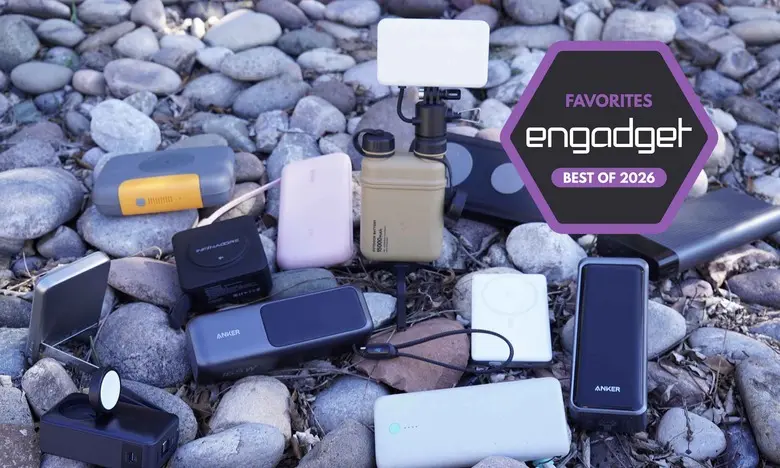
Few things feel as stressful as watching your phone’s battery percentage tumble toward zero when you’re far from an outlet. A portable power bank solves that problem, but the huge variety of models makes the choice tricky. Some are best for slipping into a pocket for a quick top-up, while others are heavy-duty bricks that can keep a laptop going for hours. After testing dozens of power banks over several years, we’ve picked the best in each category to help you find the right one for your specific needs.
Best power banks for 2026
Best MagSafe power bank: Anker MagGo Power Bank (10K)
The Anker MagGo Power Bank was among the first Qi2-certified accessories on the market, and Qi2 has made the popular MagSafe-with-kickstand design noticeably faster. In testing, it charged an iPhone 15 from near-dead to 50 percent in about 45 minutes, a substantial improvement over previous-generation wireless banks. The 10,000mAh capacity provides roughly 1.64 charges for an iPhone 15, and the integrated LCD screen shows remaining battery percentage and estimated charging times. A strong magnetic connection and a small kickstand make it convenient for watching videos while charging, and the USB-C port allows wired charging for non-Qi2 devices. Android fans will still benefit from the high-speed wireless charging if they own a newer Pixel phone with Qi2 support.
Specs: 10,000mAh, 15W wireless output, USB-C in/out, 8.82 oz
Pros: Fast Qi2 charging, sturdy kickstand, LED display
Cons: More expensive than simpler MagSafe batteries
Best portable charger for Android: Anker Nano Battery (Foldable USB-C)
The Anker Nano Battery is incredibly portable and features a built-in USB-C connector that folds away when not in use. This lets you charge a phone without needing to carry a separate cable. With a 5,000mAh capacity, it filled a depleted Galaxy S23 Ultra to 65 percent in about an hour. It’s also compact enough to keep in a pocket for emergency top-ups, making it ideal for earbuds and other small devices. The additional USB-C port can refill the battery itself or charge another device with the appropriate cable. A slightly larger 30W version with a 10,000mAh capacity and an integrated cable is also worth considering for those who want extra juice.
Specs: 5,000mAh, 22.5W max output, foldable USB-C connector, 3.5 oz
Pros: Very portable, affordable, no cable needed
Cons: Small enough to get lost in a bag
Best low-capacity power bank: Anker 10K Fusion
The Anker 10K Fusion solves two common power bank problems with its attached USB-C cable and built-in wall prongs. The foldable plug means you can recharge the power bank directly from a wall outlet without carrying an adapter, and the integrated cable ensures you always have a way to connect your phone. With a 10,000mAh capacity and 30W output, it triggered Samsung’s Super Fast Charging on a Galaxy S23, taking it from 5 percent to full in just over an hour. The 10K Fusion also displayed an accurate percentage readout on its small screen. The design is only slightly wider than a stick of butter, making it surprisingly easy to pack. The additional USB-C port and attractive texture add to the appeal. A previous favorite in this category, the BioLite Charge 40 PD, remains a solid option, but the Anker 10K Fusion offers faster charging and more features for the price.
Specs: 10,000mAh, 30W max output, built-in USB-C cable and wall prongs, 8.8 oz
Pros: Built-in cable and prongs, accurate display, affordable
Cons: iPhone charging is slower than some rivals
Best medium capacity power bank: Belkin BoostCharge 20K with Integrated Cable
Belkin’s BoostCharge 20K combines a generous 20,000mAh battery with a handy built-in USB-C cable. The cable is magnetized to stay out of the way when not in use, and there’s also a USB-A port and a USB-C port for additional devices. It delivers up to 30W of power, enough to charge a Samsung Galaxy S24 Ultra from zero to full in about 75 minutes, and an iPhone 15 to 87 percent in just over an hour. The capacity is enough for three full phone charges, making it a strong travel companion. While there’s no digital display, four indicator LEDs provide a reasonable estimate of remaining power. Available in four colors including pale pink and blue, this power bank stands out for its value and thoughtful design.
Specs: 20,000mAh, 30W max output, built-in USB-C cable, one USB-A and one USB-C port, 14 oz
Pros: Convenient built-in cable, multiple colors, great capacity for the price
Cons: Charging speed is not the fastest
Best medium-high capacity power bank: Nimble Champ Pro
The Nimble Champ Pro is a 20,000mAh power bank that charges at up to 65W. In testing, it filled a Galaxy S23 Ultra from 5 percent to full in under an hour—faster than almost any other battery in its class. It delivers nearly three full charges to both iPhone and Android phones and can refill an iPad more than once. The battery itself also recharges from the wall quickly, which is convenient when you’re in a hurry. Nimble is a certified B-Corp that uses 90 percent post-consumer recycled plastic, and the device feels solid thanks to its compact shape and attractive marbled finish. Two USB-C ports are both input and output, so you can charge two devices at a time or recharge the battery itself. One minor flaw: the four indicator lights sometimes underestimated the remaining charge during early testing, but performance stayed consistent.
Specs: 20,000mAh, 65W max output, two USB-C in/out, 12.9 oz
Pros: Super fast charging, made from recycled materials, compact design
Cons: Indicator lights are not always accurate
Best multi-device power bank: BioLite Charge 100 Max
BioLite’s Charge 100 Max is a versatile charging hub with a 25,000mAh capacity and up to 120W total output. It has four USB ports (three USB-C and one USB-A) plus a MagSafe-compatible 15W wireless charging pad. It charged an iPhone 15 five times, a Galaxy S23 Ultra four times, and even gave a MacBook Pro a partial charge in under an hour. The rounded design and rubberized texture make it comfortable to hold and travel-friendly. BioLite is known for its climate-neutral, B-Corp status and its mission to bring energy to underserved areas. While it costs more than similar-capacity batteries, the mix of wired and wireless charging options makes it a great choice for group trips or heavy device users.
Specs: 25,000mAh, 120W total output, wireless charging pad, four USB ports, 1.28 lbs
Pros: Compact and colorful design, fast multiple-device charging, socially responsible company
Cons: More expensive than competing 25,000mAh banks
Best laptop power bank: Anker Laptop Power Bank with Built-in Cable
Anker’s laptop-specific power bank ensures you’re never stuck without a charging cable. It comes with two built-in USB-C cables: one that doubles as a carry handle and a retractable cord that extends to two feet. Both support input and output, so you can charge a laptop, phone, or tablet without any extra wires. The 25,000mAh capacity delivered roughly five iPhone 15 charges and brought a MacBook Pro from empty to 68 percent in about 53 minutes. A clear display shows remaining charge and output wattage per port. With a durable matte silver shell, this unit feels more robust than previous Anker models with large screens.
Specs: 25,000mAh, 165W max output, two built-in USB-C cables, USB-A port, 1.31 lbs
Pros: Two built-in cables, durable build, fast charging
Cons: Display can pick up smudges
Best premium power bank: Anker Prime Power Bank 26K 300W
The Anker Prime Power Bank is a high-end, 26,250mAh battery that pushes out up to 300W. It has two USB-C ports (each delivering up to 140W) and a USB-A port, allowing you to charge two high-powered laptops simultaneously if needed. The built-in display shows remaining charge, output wattage, and battery temperature. During tests, it powered an iPhone 15 to 60 percent in 30 minutes and delivered more charge to a MacBook Pro than any other portable battery evaluated. The optional charging base, sold separately, lets you recharge the power bank by simply dropping it down—a convenient luxury. Though the battery alone costs around $200 and the base adds another $110, this is the best choice for those who want maximum performance and a sleek, premium design.
Specs: 26,250mAh, 300W max combined output, two USB-C 140W ports, one USB-A port, 1.32 lbs
Pros: Extremely fast charging, elegant design, detailed display with temperature gauge
Cons: Expensive, optional charging base costs extra
Best power bank for outdoors: Nestout 15000mAh Outdoor Battery Power Bank
The Nestout 15000mAh is built for rugged conditions. With an IP67 rating, it can survive immersion in up to a meter of water for 30 minutes, thanks to screw-on caps with silicone gaskets. It also met military-standard shock requirements in drop tests from chest height onto hard surfaces. The bank’s charging speed is moderate—it took about two hours to fill an iPhone 11—and the included USB-A-to-USB-C cable is quite short. However, Nestout offers useful accessories, including a snap-on LED worklight and a small tripod, as well as a solar panel that refilled the battery to 40 percent in under three hours during sunny testing. For hiking, paddling, or any outdoor adventure where water and bumps are a risk, this is a dependable companion.
Specs: 15,000mAh, 32W max output, USB-C and USB-A ports, IP67 waterproof, 12.8 oz
Pros: Waterproof, shockproof, great accessories
Cons: Charging slower than competitors, short included cable
What to look for in a portable battery pack
Battery type and capacity
Almost all portable power banks use lithium-ion cells because they pack a lot of charge into relatively small sizes. You’ll usually see capacity listed in milliamp-hours (mAh). A 5,000mAh bank can typically top off a smartphone to 50–75 percent, while a 20,000mAh model can handle multiple phone charges or partial laptop charges. Keep in mind that real-world efficiency is around 60 percent due to heat loss and voltage conversion, so a 20,000mAh charger will actually deliver about 11,000mAh to your device.
Wireless charging and ports
Wireless power banks are now genuinely useful thanks to the Qi2 standard, which supports up to 15W and magnetic alignment. The latest Qi2 25W spec is already showing up in new iPhones and Pixel phones, with more power banks supporting it soon. Wired connections remain faster and more efficient, but wireless adds convenience. Look for USB-C ports with higher wattage for laptops, and make sure your charging cable supports the same wattage.
Flying with portable batteries
The TSA allows external batteries up to 100Wh in carry-on luggage only; they are forbidden in checked bags. Most standard power banks fall under this limit. Some airlines like Southwest have introduced stricter rules, requiring passengers to keep power banks visible while in use on board. Always check your airline’s policy before traveling.
How we test power banks
We test each power bank by draining a range of devices to near zero and then charging them until they’re full or the battery pack runs out. For phones, we use recent iPhone and Galaxy models; for larger banks, we also test with iPad Air and MacBook Pro. We measure charging times and count how many full or partial charges each battery provides. We also evaluate features like ease of carrying, indicator lights, built-in cables, and drop/water resistance when applicable. This testing process is updated as new products launch, ensuring recommendations remain relevant.
Other power banks worth mentioning
Several other models stood out during testing. The Belkin Stage PowerGrip is more than a power bank—it’s a magnetic battery with a Bluetooth shutter and tripod mount, ideal for mobile photographers. The Anker MagGo for Apple Watch adds a small pop-up watch charger to a 10,000mAh battery, perfect for travelers who also need to keep a smartwatch alive. HyperJuice 245W offers huge 27,000mAh capacity and four USB-C ports, but lacks a USB-A port and is beaten on value by Anker’s built-in-cable laptop bank. The EcoFlow Rapid magnetic power bank is a decent Qi2 option with a small 5,000mAh capacity and a clever pull-out leg. Mophie Snap+ Powerstation Mini is also well-made but provides only a 5,000mAh charge and lacks the extra features of Anker’s MagGo.
Power bank FAQs
What's the difference between a power bank and a portable charger?
Terms like power bank, portable charger, external battery, and USB charger are largely interchangeable. They all refer to a standalone rechargeable battery that can charge your devices. A power station is a much larger unit, often the size of a car battery, which can charge appliances and is not allowed on airplanes.
Does fast charging ruin your battery?
Not exactly. Heat is the main enemy of battery health, and fast charging does generate more heat, but modern phones use heat shields and software to control temperature. While studies have shown a slight long-term capacity drop from frequent fast charging, the safeguards in current smartphones make the difference minimal. The best practice is to avoid exposing your device to excessive heat while charging.
Can you use a power bank for all your devices?
It depends on the power bank’s capacity and your device’s charge requirements. A 20,000mAh bank can partly charge a laptop, while smaller 5,000mAh models are best for phones and earbuds. As long as your device has a USB port and the power bank has enough output wattage, you should be able to charge it with the right cable.
Source:Engadget News