

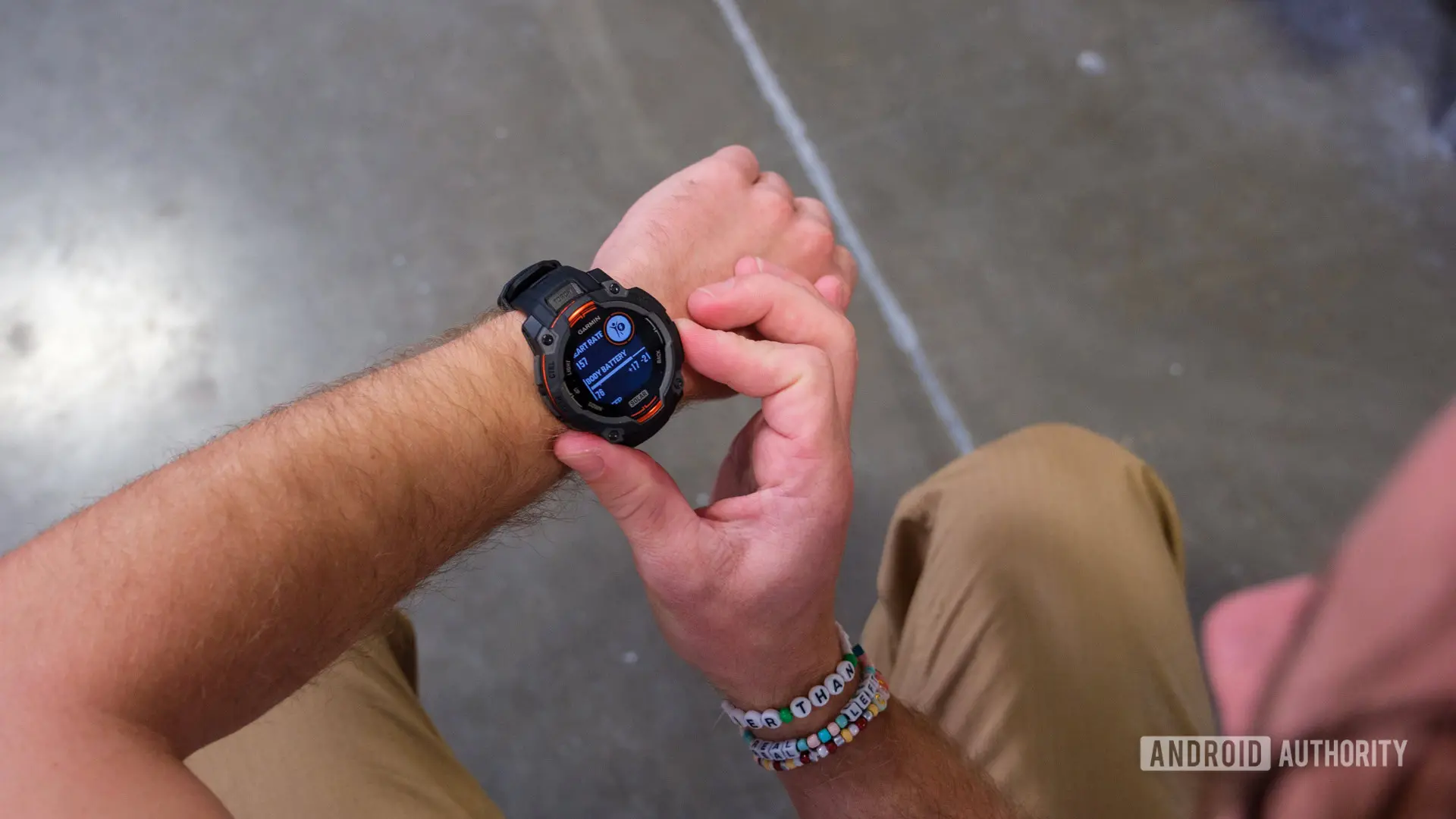
As I look at the Galaxy Watch 4 clasped to my wrist, I feel little desire to upgrade to a new Samsung model. There’s much excitement surrounding the incoming Galaxy Watch 9 and Galaxy Watch Ultra 2, and the recent rollout of the upgraded Health app teased a plethora of new features. Fitness index? Vitals? Hearing health!? They all read pretty exciting on paper. But after many years, Samsung and its contemporaries have yet to properly recreate a Garmin feature that wraps my entire day’s activity into a neat number. That feature? Body Battery.
What is Garmin’s Body Battery score?
It’s been nearly a decade since Garmin launched Body Battery and several years since I last used a Garmin. Absence, as they say, makes the heart grow fonder. In a nutshell, the Body Battery score approximates a user’s energy level throughout the day, with 0 being the lowest possible value and 100 the highest. The score uses several physiological factors in its calculation, including heart rate, sleep quality, and heart rate variability (HRV) — a strong indicator of overall bodily stress.
Think of Body Battery as your state of charge. That probably sounds similar to other holistic scores, but Body Battery differs in one key way. I can “recharge” my score — or earn positive points — by resting, sleeping, or napping. Alternatively, any physical exertion costs points. The more I demand of my body, the lower my score will drop. Conversely, I can top it up again by catching a quick snooze on the couch in the middle of the day. It’s unlike Samsung and Google’s equivalents, which remain static until the next morning.
To simplify it further, Body Battery can essentially be viewed as the body’s “state of charge,” and this framework makes it easy for newcomers and advanced users alike to understand and utilize. There’s no need for the rambling AI anecdotes often paired with its rivals’ scores. Body Battery’s constant flux is one of the features I genuinely love. We’re not static beings, nor do we start a new day at zero. Since the Body Battery’s value rolls over from the previous day, each action throughout the day feels more consequential and more meaningful.
Wait, doesn’t Samsung have a Body Battery equivalent?
Not quite. While you could argue that Samsung has a de facto equivalent feature in Energy Score, there are several marked differences between the two. For one, Energy Score updates only once a day and relies heavily on sleep stats. Oversleep just a little or miss a particular sleep zone, and you can expect a low Energy Score in return. This doesn’t quite reflect the amount of energy you might have to expend that day. While it does factor in activity too, it’s a much smaller portion of the overall number.
Unlike Body Battery, Energy Score remains static, updating once a day. There’s also a delay when finding out just how much yesterday’s weight session took out of me with Energy Score. Given Body Battery’s fluid nature, it will let me know a few minutes after completion just how much it has affected me. Can I continue, or should I stop and rest? Only one score offers me more immediate insight.
Notably, Body Battery is also incredibly useful for pacing myself, and I don’t mean on runs. If I wake up feeling terrible and my battery is lower than the day before, I know that I’ll need to work a little slower or work out a little lighter. I can spread myself slowly across the unfolding 24 hours by monitoring the small hits to my Body Battery. And, if it falls too low, I can top it up again with a brief rest. If I’m feeling great and my score is nearing 100, I know I can push far harder for longer without incurring an energy penalty the next day. Just as a calendar helps me budget my time, Garmin’s feature helps me budget my theoretical energy.
Assigning a number to such a nebulous concept as the amount of energy one has is, obviously, not an exact science. If anything, there are so many variables along the process that it’s effectively impossible to quantify this. A watch might miss a step or overstate the amount of REM sleep one garnered, which can easily affect scores in the future. All companies can do is provide a best guess based on the data accrued. Anecdotally, I’ve felt that Garmin’s feature does a better overall job of scoring how I actually feel in the moment.
The Galaxy Watch 9 is nearly here, but I’m looking elsewhere
On the eve of the Galaxy Watch 9 series launch and given the aging smartwatch strapped to my arm, I’m certainly weighing my upgrade options. I could continue along Samsung’s path of super-specific health scores that cover niche facets of one’s health and wellness. I’m a sucker for gamification and spider charts, so the Fitness Index is one feature I’m certainly thirsting for. This is just one of the many treats coming to Samsung fans’ wrists, and I have little doubt that more will arrive in the future.
The problem I have with this concept is that more scores don’t always mean more useful information. Splitting how I feel into numerous numbers only makes it harder to understand how I feel and why I might feel it. In an ideal world, the Energy Score would do just that, but it doesn’t. Body Battery does. It might not be perfect, but Body Battery is still the best overall energy estimate I’ve ever used. It’s easily understandable, responds to my actions throughout the day, and provides me with a known baseline that shifts with me. Some might prefer static scores, but our bodies are never truly in stasis, even when we’re standing still.
To understand why this matters, consider the broader landscape of health wearables. Over the past few years, companies like Samsung, Apple, and Google have flooded the market with a dizzying array of metrics. Sleep scores, readiness scores, stress scores, activity scores – each aiming to quantify some aspect of well-being. While these tools can be valuable, they often overwhelm users with data without providing a clear, actionable takeaway. Garmin’s Body Battery, on the other hand, offers a single number that synthesizes multiple inputs into a coherent picture of your physical capacity. It’s a philosophy that prioritizes simplicity over complexity.
Historically, Garmin has focused on athletes and outdoor enthusiasts, but Body Battery appeals to a wider audience. The feature first appeared in 2019 as part of the Garmin Connect platform, and it quickly became a favorite among users for its intuitive design. The underlying algorithm incorporates heart rate variability, which measures the time interval between heartbeats. High HRV indicates a relaxed state, while low HRV suggests stress or fatigue. By combining HRV with sleep data, Garmin’s system provides a near-real-time gauge of your body’s energy reserves.
In contrast, Samsung’s approach reflects a different design philosophy. The Galaxy Watch line has gradually evolved from a simple fitness tracker to a comprehensive health hub. With each generation, Samsung adds more specialized metrics: blood pressure monitoring, ECG, skin temperature, and now the Fitness Index, which evaluates cardiorespiratory fitness. Yet these additions often feel like siloed features rather than part of an integrated system. The Energy Score, introduced in late 2023, was meant to serve as a unifying metric, but its static nature undermines its utility.
The gap between the two companies becomes even clearer when you look at user feedback. Polls show that only about 26% of Garmin users find Body Battery very useful and accurate, while another 21% consider it somewhat useful. Meanwhile, a significant portion of respondents don’t use the feature at all, either because they don’t own a Garmin device or because they prefer other metrics. Nevertheless, for those who do use it, Body Battery often becomes a key reason to stick with the brand. Its dynamic updates allow for real-time adjustments – something that static scores cannot replicate.
As Samsung prepares to launch the Galaxy Watch 9, it faces a critical decision. Will it continue down the path of expanding its portfolio of health features, or will it refine existing ones to match the fluidity of Garmin’s offering? Early leaks suggest the Galaxy Watch 9 will include improved sleep tracking and an updated BioActive sensor, but there’s no indication that Samsung plans to overhaul the Energy Score. For users like me, that’s a missed opportunity. A truly integrated energy metric could be the difference between staying loyal to Samsung or switching to a competitor.
Of course, the Galaxy Watch 9 offers other advantages: a brighter display, longer battery life, and tighter integration with Samsung phones. The upcoming Galaxy Watch Ultra 2 also promises better durability for outdoor activities. But health features remain a major selling point in the smartwatch market, and Samsung’s current approach feels fragmented. Until the company delivers a dynamic, real-time energy score that responds to the body’s fluctuations, I’ll be tempted to look elsewhere.
Source:Android Authority News