






















Trading vs Investing – What’s the Real Difference?
Explore the difference between trading and investing in this simple guide. Ideal for stock market coaching, stock market classes, and curious beginners.

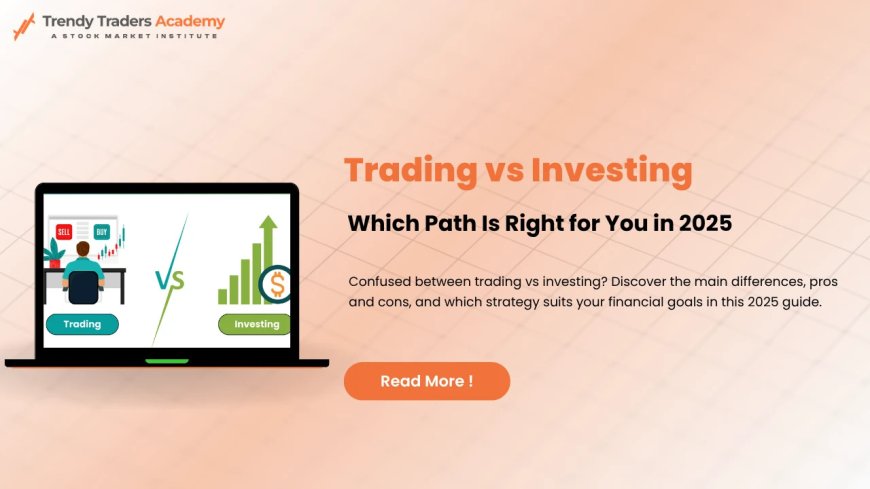
Trading vs Investing: Understanding the Key Differences in the Stock Market
Introduction
Have you ever found yourself wondering, Should I be trading stocks or investing in them? If yes, youre not alone. Many people step into the stock market unsure of what either means. These two termstrading and investingare often used interchangeably. But in reality, theyre as different as sprinting and marathon running.
Understanding the difference between trading and investing is key for anyone looking to grow their wealth. And dont worrythis article wont throw confusing stock market jargon at you. Whether youre just curious or looking for stock market coaching or even stock market classes, this guide is for you.
Explore the difference between trading and investing in this simple guide. Ideal for stock market coaching, stock market classes, and curious beginners.
What is Trading?
Trading is like flipping a product for profitbuy low, sell high, and move fast. Traders aim to make quick gains by buying and selling stocks (or other assets) over a short time, sometimes just hours or even minutes!
There are different types of trading:
-
Intraday Trading Buying and selling within the same day.
-
Swing Trading Holding stocks for a few days or weeks.
-
Position Trading Holding for a few months.
Its fast-paced and excitingbut its also riskier.
What is Investing?
Investing is more like planting a tree. You water it, give it sunlight, and wait for it to grow over time. Investors buy assets with the intention of holding them for years, even decades, to benefit from compound growth.
They look for:
-
Stable companies
-
Long-term gains
-
Dividend income
This approach is less stressful but requires patience and consistency.
Time Horizon: Short vs Long Term
One of the biggest differences between trading and investing is the time commitment.
-
Traders are short-term players. They may not hold a stock for more than a few minutes.
-
Investors play the long game5, 10, or even 20 years.
If you're someone who checks the stock prices every hour, trading might suit you. If you're happy to "buy and forget," investing may be your style.
Risk Level: How Much Are You Willing to Lose?
Lets face it: risk is everywhere in the stock market. But traders and investors take different kinds of risks.
-
Traders face high risk due to market volatility.
-
Investors face moderate risk since time tends to smooth out the ups and downs.
A trader could lose 10% of their capital in a single day. An investor, meanwhile, might ride through a dip and eventually recover.
Goals: Quick Profits vs Long-Term Wealth
Ask yourself: Whats my goal?
-
Traders want quick profits.
-
Investors aim for long-term wealth creation.
If you need regular cash flow or like adrenaline, trading may be appealing. If you're saving for retirement or your childs education, investing is more suitable.
Skill Set Needed: Fast vs Patient Thinking
Trading requires:
-
Quick decision-making
-
Market timing
-
Chart reading skills
Investing requires:
-
Patience
-
Fundamental analysis
-
Emotional control
You need to ask yourself, Am I a sprinter or a marathon runner?
Tools of the Trade
Traders rely on:
-
Technical charts
-
Real-time news
-
Stop-loss orders
Investors use:
-
Balance sheets
-
Earnings reports
-
Valuation ratios
Both need toolsbut different ones. This is where stock market classes can really help. Learning how to use these tools can make a huge difference.
Market Analysis Approach
There are two main types of analysis:
-
Technical Analysis Predicting short-term price movements using charts (used by traders).
-
Fundamental Analysis Studying company performance and future growth (used by investors).
Traders are analysts of emotion; investors are analysts of value.
Emotional Discipline
Believe it or not, your emotions can make or break your success.
-
Traders must control fear and greed constantly.
-
Investors must resist panic during market crashes.
Whether you trade or invest, you need disciplinewhich is something that good stock market coaching can teach.
Capital Requirement
You dont need lakhs of rupees to start either one, but:
-
Traders may require more frequent capital injections for margin trading.
-
Investors can start small and scale up.
With SIPs (Systematic Investment Plans), you can start investing with as little as ?500/month.
Tax Implications
In India, taxation differs:
-
Short-term capital gains (STCG) tax applies to profits held for less than a year (traders).
-
Long-term capital gains (LTCG) apply after 1 year, often at lower rates (investors).
So, if you're making frequent trades, expect to pay more in taxes.
Which is Right for You?
Theres no one-size-fits-all. Ask yourself:
-
Do I have time to watch markets?
-
Can I handle volatility?
-
What are my financial goals?
You might even try both before settling on one.
Can You Do Both?
Absolutely! Many people:
-
Invest 80% of their capital for the long term
-
Trade 20% to take advantage of short-term opportunities
Its like having a day job (investing) and a side hustle (trading).
Stock Market Coaching and Classes
Still confused? Thats totally fine! This is where stock market coaching and stock market classes come in. They help you:
-
Understand the basics
-
Develop a personalized strategy
-
Avoid beginner mistakes
Look for certified trainers or courses that offer both practical and theoretical learning.
Final Thoughts
So, whats the verdict? Well, it depends on you.
Trading and investing are just two roads to financial freedom.
One is fast, thrilling, and risky. The other is slow, steady, and (usually) more reliable.
Instead of choosing one over the other, learn both, experiment, and decide what works best. And rememberknowledge is your best investment.
FAQs
1. What is the main difference between trading and investing?
Trading is short-term and focuses on quick profits, while investing is long-term and focuses on wealth creation.
2. Can a beginner start with trading?
Yes, but it's recommended to take stock market classes or get stock market coaching to understand the risks and techniques first.
3. Which is more profitable: trading or investing?
Both can be profitable. Trading offers quicker returns with higher risk, while investing offers safer returns over time.
4. Is trading riskier than investing?
Yes, trading generally involves higher risk due to rapid price movements and market volatility.
5. Do I need a lot of money to start trading or investing?
No. You can start small in both. However, trading may require more active capital if using leverage or margin.