

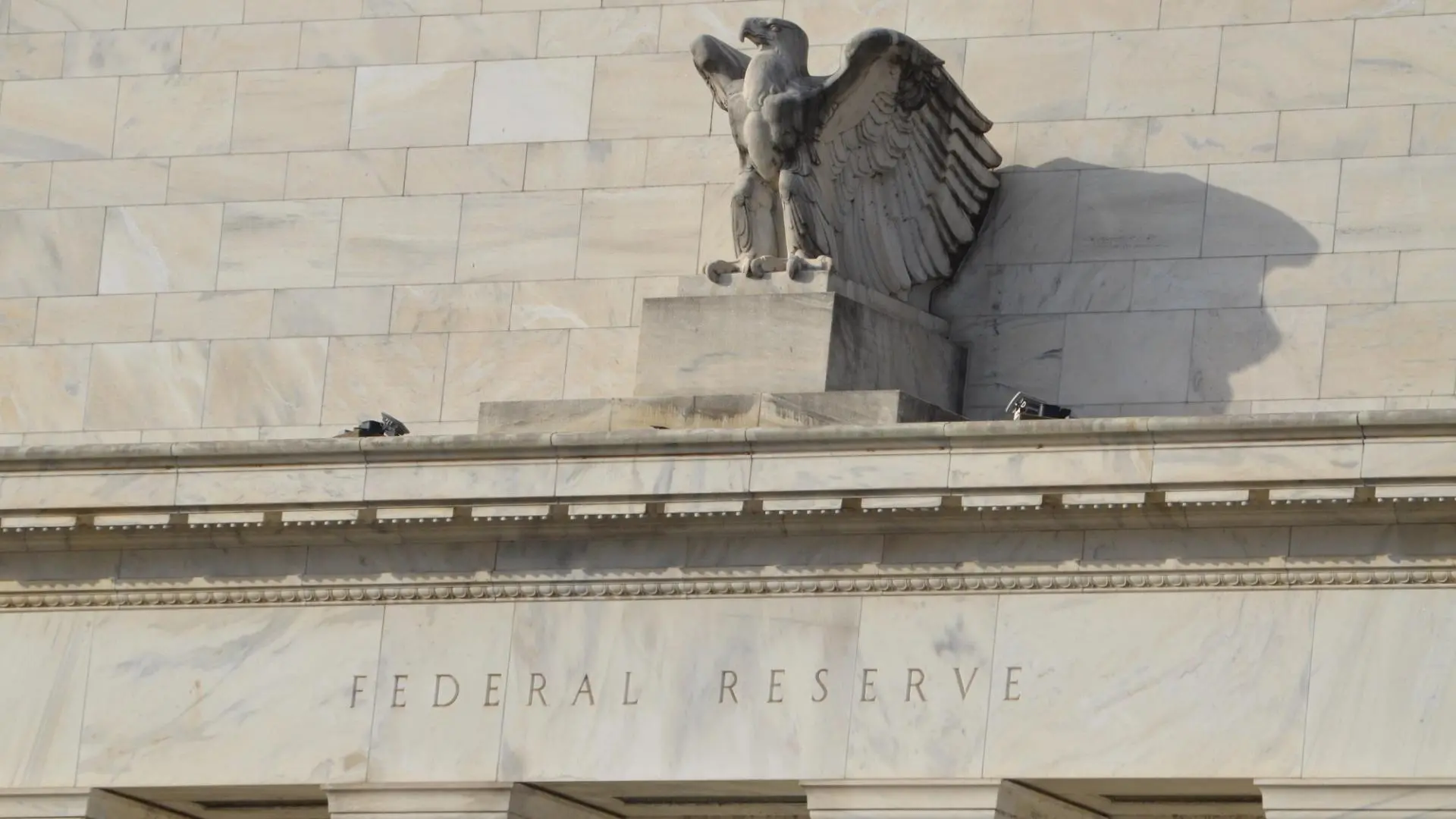
Bitcoin traded above $64,000 on Wednesday as the Federal Reserve held its benchmark interest rate steady for a sixth consecutive meeting. The decision, widely expected but not fully certain, came with a hawkish tilt from new Chair Kevin Warsh, who emphasized that there is no soft inflation target. Cryptocurrencies initially extended gains after the announcement, with bitcoin rising 1.25% to $64,500 before settling near $64,000.
Fed holds rates, but not without dissent
The Federal Open Market Committee left the fed funds rate range at 3.50%-3.75%, matching the consensus expectation. However, the decision was far from unanimous, with three dissents. Markets had priced in roughly a 65% chance of a hold and a 35% chance of a quarter-point hike, an unusually high level of uncertainty for a Fed meeting. CME FedWatch data showed that traders were divided, with some major institutions like Citadel Securities expecting an increase to shore up Warsh's inflation-fighting credibility.
Warsh's post-meeting press conference struck a hawkish chord. He opened by stating, “There is no soft inflation target,” reiterating his view that any inflation print above 2% is unacceptable. He also addressed the internal debate, saying the key question was whether raising rates would actually fix the current inflation spurt. He implied that higher rates might not cure inflation driven by the Iran-related oil price spike and the AI-driven rise in memory chip prices.
Warsh downplayed the Fed's role in the recent sharp rise in yields. “Even if we haven't done much, markets have quite a bit,” he said, suggesting that the central bank is observing the move but not intervening. He also acknowledged the robust discussion at the meeting, saying he was “asked for a good family fight and I got one.”
Market reaction: Yield curve steepens, stocks wobble
The Fed's decision triggered a steepening of the yield curve. The ten-year Treasury yield jumped 5.5 basis points to 4.66%, while the two-year yield slid six basis points to 4.22%. That movement reflected the unwind of bets on a rate hike. A steeper curve can signal that markets are baking in higher inflation expectations.
U.S. stocks initially narrowed losses but turned lower again. The Nasdaq Composite was down 0.6% and the S&P 500 fell 0.75%. Earlier in the session, the Nasdaq had been down more than 1.5% before recovering somewhat. By the close, the Nasdaq was on track for its worst month in nearly four years, down about 9.5% in July.
The AI trade continued to weigh on the broader market. Familiar former favorites like SanDisk, Micron, AMD, Applied Materials, and KLA Corp. fell 3%-6%, while Nvidia dropped 2.4%. The VanEck Semiconductor ETF (SMH) was down 2.5% on the day and nearly 20% for the month. Goldman Sachs noted that the selloff was more about deleveraging and de-grossing than a macro shift, saying that “everyone owned some version of the AI momentum trade.”
Microsoft and Meta earnings diverge
After the bell, two tech giants delivered contrasting results. Meta reported a second-quarter earnings miss, with EPS of $6.18 versus the Street's $7.14 estimate. Revenue of $60.8 billion narrowly beat expectations of $60.4 billion. The midpoint of third-quarter revenue guidance of about $63 billion was in line with estimates. Meta also lifted the lower end of its full-year AI-related capex guidance to $130 billion-$145 billion, up from $125 billion-$145 billion previously. Shares fell 5.4% in after-hours trading.
Microsoft, on the other hand, beat on both top and bottom lines. The company reported fiscal fourth-quarter EPS of $4.74 versus $4.24 expected, and revenue of $90.1 billion against $87.6 billion expected. Microsoft did not include its all-important capex spending guidance in the initial release, but executives were expected to provide details during the earnings call. Shares rose 2% after-hours, helping to offset some of the negative sentiment from Meta.
Oil surges on Iran tensions
A major driver of market volatility on Wednesday was renewed Middle East tension. U.S. forces in Jordan were reportedly attacked by missiles overnight in what the Wall Street Journal described as a “surprise attack.” The missiles were intercepted and caused no damage, but oil prices reacted sharply. WTI crude surged 4.3% to $82.68 in early trading.
Later, President Trump told Fox News that Iran would be “hit hard” in response to the attack. That comment extended oil's rally to nearly 7%, pushing it to $84.63 per barrel. The spike in oil added to inflation concerns and pressured risk assets. Bitcoin edged lower but remained higher for the day.
Bitcoin's resilience amid uncertainty
Bitcoin showed remarkable stability despite the uncertain Fed outlook and geopolitical flashpoints. The bitcoin implied volatility index (BVIV), often called the fear gauge, stayed below 40%, well off the highs seen during early June and February selloffs. This low reading suggested limited demand for protective options and indicated that traders saw little reason to brace for sharp price swings.
Analysts also pointed to a potential rotation from AI stocks into crypto. The Kospi, South Korea's benchmark equity index, dropped 6% on Wednesday and was down about 40% from its June peak, led by declines in Samsung Electronics and SK Hynix. 10x Research suggested on X that as the AI trade gets repriced, bitcoin may capture some of the value. “If that correlation holds, Anthropic and OpenAI are due for a serious repricing, and the reason isn't demand, it's commoditization,” the research firm said.
Cathie Wood rotates away from crypto-linked equities
In a notable move, Cathie Wood's ARK Invest bought about $12 million of SpaceX stock on Tuesday, adding 105,108 shares across its ETFs. SpaceX shares traded at $116.41, up 2.6%, but they are still 29% below the June IPO price of $135. ARK also sold crypto-linked names, trimming $4 million of Robinhood, $2.3 million of Block, and $1.6 million of Bullish. The firm added small positions in Bitmine and a Solana staking ETF, but the larger rotation was clearly out of crypto equities and into AI and space names.
Morgan Stanley said this week that SpaceX's selloff had pushed the stock to a level that prices its AI business at zero, while maintaining a $300 target. The rotation by one of the market's most vocal bitcoin bulls into a beaten-down AI-and-space stock signaled a shift in risk appetite.
Morgan Stanley sees tokenization as crypto's on-ramp
Morgan Stanley executives said tokenization could bring digital assets to a broader group of investors. During a panel discussion, investment strategist Denny Galindo said tokenized products are gaining momentum and could become the first exposure many people have to blockchain-based finance. “I think we're going to see a lot of mainstream impact from something tokenized that people can buy that they used to have a hard time getting access to,” Galindo said. “That'll probably be the first way crypto reaches people who aren't thinking about it all the time.”
Galindo added that many investors have stopped at bitcoin, but growing access to ETFs and other digital asset products is creating new opportunities for portfolio construction. He noted that the appropriate allocation depends on whether investors view bitcoin as digital gold, a venture-style investment, or a portfolio diversifier. He also said that venture capital has largely flowed toward AI, limiting investment in other emerging technologies. “Everyone wants to spend their venture capital money on AI,” he said. “If that turns, I think there are a lot of opportunities here in crypto that people will be able to invest in.”
Zuckerberg opposes Chinese AI ban
Meta CEO Mark Zuckerberg told the Financial Times that banning Chinese AI in the U.S. would not be “an effective solution.” His comments came after China's Moonshot AI released its Kimi K3 model and U.S. officials accused the company of secretly training it using outputs from OpenAI and Anthropic. Zuckerberg argued that the U.S. should instead “systemically” identify bottlenecks and roadblocks to better compete with China.
Smaller tokens outperform
In the crypto market beyond bitcoin, several smaller tokens led gains. Audiera's BEAT token was up 28% over 24 hours, the best performance among the top 100 tokens by market value. Uniswap's UNI gained 7.2%, and Jupiter's JUP rose 7%. The CoinDesk DeFi Select Index added 2.8%. Ether rose 1.7% to $1,909, and XRP led majors with a 2.6% gain.
South Korea's Kospi continued its slide, dropping 6% on Wednesday and extending a bear market that began in June. The index has now fallen nearly 40% from its peak. Analysts suggested that capital outflows from overheated AI trades could potentially find their way into crypto markets, with bitcoin seen as a possible beneficiary of a repricing in AI valuations.
As the trading day wound down, bitcoin held just below $64,000, up modestly over 24 hours. The Fed's hold, combined with geopolitical tensions and earnings surprises, left markets in a cautious mood. Oil prices remained near session highs, and Treasury yields stayed elevated. Investors now look to the Fed's next moves and the ongoing rotation between AI, crypto, and traditional assets.
Source:Coindesk News