

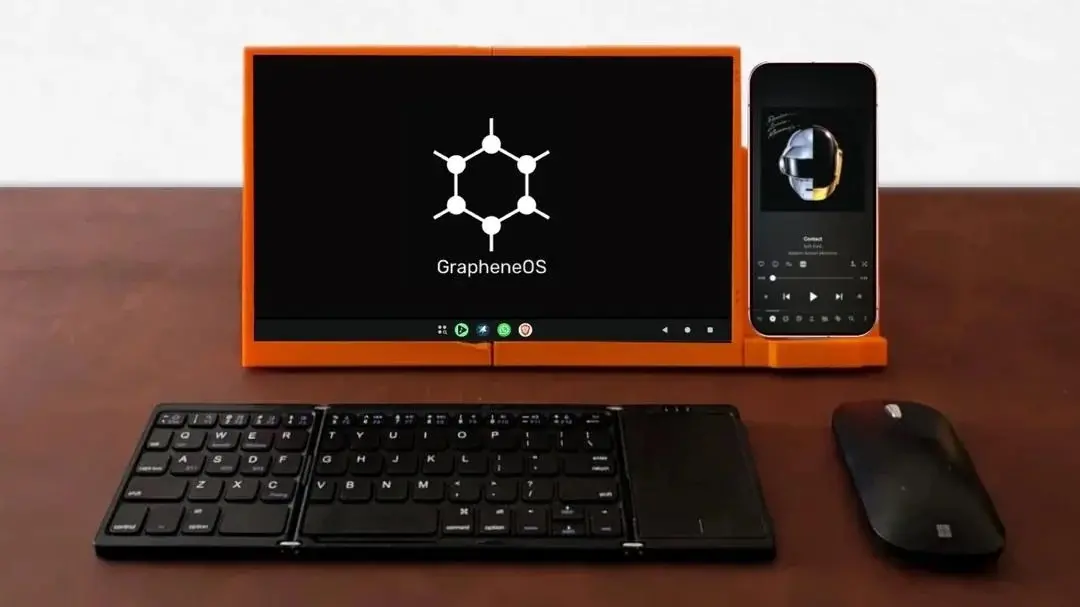
A Lapdock That Finally Makes Sense for GrapheneOS Users
For years, the idea of using a smartphone as a primary computer has been a tantalizing but elusive dream. Samsung’s DeX, while polished, remains tethered to proprietary ecosystems. Google’s own desktop mode, introduced with Android 14 and refined in later versions, has yet to see widespread adoption. Enter the GrapheneOS community—a group of privacy-focused developers and enthusiasts who believe that a Pixel running a hardened operating system can do more than just protect data; it can replace a laptop entirely.
A Reddit user known as Rolf_0 has taken this philosophy to its logical extreme, creating a custom lapdock for the Pixel 9 running GrapheneOS. The result is a portable, modular device that transforms the smartphone into a desktop-class machine, while still allowing the phone’s own display to serve as a secondary screen. It is, to put it mildly, one of the most creative DIY projects to emerge from the Android ecosystem in recent memory.
The Backstory: From Prototype to Final Build
The project began roughly three months ago, when Rolf_0 shared an early prototype on Reddit. The initial version was rough—a few 3D-printed brackets, a loose keyboard, and a tangle of cables. But the response from the GrapheneOS community was overwhelmingly positive. Users praised the vision and offered suggestions for improvement. Encouraged, the creator went back to the drawing board, refining the design until it reached a state that could be called production-ready.
The final version, showcased in a detailed YouTube video, is a self-contained unit. The centerpiece is a 3D-printed chassis that houses a display controller board, a power bank, USB-C and HDMI ports, and a dock for the Pixel 9. A folding Bluetooth keyboard snaps onto the front for transport, and when it’s time to work, the keyboard detaches completely, allowing the user to place it wherever is most comfortable. The creator deliberately avoided copying the clamshell form factor of traditional laptops, opting instead for a folding mechanism inspired by the gull-wing doors of sports cars.
Design Philosophy: Modularity Over Obsolescence
One of the most compelling aspects of this lapdock is its modularity. Every component can be individually replaced: the display, the power bank, the keyboard, the mouse, and the phone itself. If the battery in the power bank degrades after a few years, you don’t need to scrap the entire device—just swap in a new power bank. If the keyboard breaks, print a new bracket and buy a compatible Bluetooth keyboard. This design ethos stands in stark contrast to the sealed, unrepairable laptops that dominate the market today.
The creator has also integrated a shoulder-strap mechanism, turning the lapdock into something you can sling over your shoulder like a messenger bag. A Bluetooth mouse slides into a dedicated compartment at the back of the chassis. The stand has been reinforced with additional bracing to ensure stability when typing on a desk or on one’s lap. Every detail seems to have been considered, from the weight distribution to the placement of ports.
Android Desktop Mode: The Missing Link
At the heart of this setup is Android’s Desktop Mode, a feature that has been quietly evolving since Android 10. When a Pixel phone is connected to an external display via USB-C or HDMI, the interface shifts to a windowed environment reminiscent of a traditional desktop operating system. Apps can be resized, stacked, and moved around. A taskbar appears at the bottom, and notifications can be managed with a mouse and keyboard.
In GrapheneOS, Desktop Mode gains an extra layer of security and privacy. The operating system is hardened against exploits, includes a firewall, and offers granular permission controls. For users who value digital sovereignty, this combination is powerful: a phone that doubles as a secure laptop without any of the tracking or telemetry found in mainstream operating systems.
The lapdock takes full advantage of this. When the Pixel 9 is docked, the external 15.6-inch display (the specific model is not mentioned, but it appears to be a standard portable monitor) functions as the primary screen. Meanwhile, the phone’s own 6.3-inch OLED display can be used as a secondary monitor—perfect for chat apps, reference materials, or system monitoring. This dual-screen capability is something even many laptops lack.
Why This Matters: The Phone-as-Computer Revolution
The project taps into a broader trend: the growing power of flagship smartphones. The Pixel 9, with its Tensor G5 chip (or whatever Google names its custom silicon in 2026), is capable of running full desktop applications through virtualization, remote desktop clients, or native Android apps. For many productivity tasks—word processing, email, web browsing, coding, even light photo editing—the phone’s horsepower is more than sufficient.
Rolf_0 makes an insightful point: using a phone as your primary computer means every smartphone upgrade also upgrades your “laptop.” Instead of spending $1,000 on a new laptop every few years, you simply dock your new phone into the same lapdock. The cost savings, combined with reduced e-waste, are significant. Moreover, the lapdock itself can be upgraded piecemeal as better components become available.
The creator has released the full design files on a platform like Printables or Thingiverse, along with a bill of materials and assembly instructions. For those without a 3D printer, online manufacturing services can print the parts at a reasonable cost. The total price for a build is estimated to be around $200 to $300, not including the phone or the display. That’s a fraction of the cost of a typical laptop.
Technical Details: Inside the Build
From the video walkthrough, we can glean several technical specifics. The chassis is printed in multiple pieces, likely using PLA or PETG filament for strength. A display controller board is mounted inside to handle video input from the phone via USB-C. The power bank, with a capacity of at least 20,000 mAh, provides juice to the display and can also charge the phone. A dedicated USB-C hub with HDMI output is integrated into the design, allowing the phone to output video while being charged simultaneously.
The keyboard is a standard Bluetooth folding unit, but the creator has designed a custom snap-on mount that holds it securely during transport. The mouse is a compact Bluetooth model that fits into a slot at the rear. The entire assembly weighs approximately 2.5 pounds, making it lighter than most modern laptops.
One of the cleverest touches is the phone dock itself. It positions the Pixel 9 at a slight angle, allowing the rear camera to peek out—useful if you want to use the phone for video calls while docked. The dock also has a cutout for the fingerprint sensor and front-facing camera, ensuring that biometric authentication remains accessible.
Community Response and Future Plans
The GrapheneOS community has embraced the project with enthusiasm. In the Reddit thread, commenters have asked about variations for other Pixel models (the Pixel 8 series, for instance) or for non-GrapheneOS phones. The creator has indicated that while this is the final version of this particular lapdock design, they plan to release more DIY lapdock designs in the future—potentially supporting different screen sizes, keyboard layouts, or even tablet devices.
For now, the files are available under a permissive license, allowing anyone to modify and improve the design. Given the open-source ethos of both GrapheneOS and the maker community, it’s likely that iterations will appear. Perhaps someone will add a trackpad, or integrate speakers, or incorporate a proper hinge mechanism.
The project is a reminder that the smartphone, for all its convenience, has long been held back by the lack of good docking solutions. With the Pixel 9 and GrapheneOS, that barrier is finally breaking down. The lapdock may not be a mass-market product, but it doesn’t need to be. It’s a proof of concept—a glimpse of what’s possible when passionate individuals take matters into their own hands.
Broader Implications: The End of the Traditional Laptop?
While it’s too early to declare the death of the laptop, projects like this one highlight the shifting landscape. Arm-based processors, improved graphics capabilities, and desktop-class operating systems on phones are blurring the lines between categories. Companies like Motorola have tried lapdock-style accessories before (the Moto Z series and the Lapdock), but those were tethered to specific hardware and lacked the open modularity of this DIY approach.
What sets this project apart is that it’s built on GrapheneOS—a security-focused OS that appeals to journalists, activists, and privacy-conscious users. For these individuals, a phone that doubles as a secure laptop is not a luxury; it’s a necessity. The ability to carry a full computer in a form factor smaller than a laptop—and to keep that computer disconnected from Google’s and Apple’s ecosystems—is a powerful proposition.
The creator has also addressed the issue of thermal management. In the video, they note that the Pixel 9’s graphene-based cooling system works well even during extended use, and the lapdock’s open design allows for passive airflow. The power bank is placed away from the phone to avoid heat buildup. These small engineering decisions contribute to a stable, usable experience.
For anyone considering building their own lapdock, the takeaway is clear: the components are affordable, the instructions are detailed, and the result is a device that could genuinely replace a laptop for many tasks. Whether you’re a developer writing code on a train, a student typing essays in a library, or a freelancer editing documents in a café, this setup offers flexibility without compromise.
Ultimately, this project is a testament to what the GrapheneOS community stands for: taking control of your hardware and software. By releasing the design files, Rolf_0 has paid it forward, ensuring that others can learn, iterate, and improve. The lapdock may look unconventional, but that’s precisely the point. It’s not trying to be a laptop—it’s something better. It’s a phone that becomes whatever you need it to be.
Source:Android Authority News