

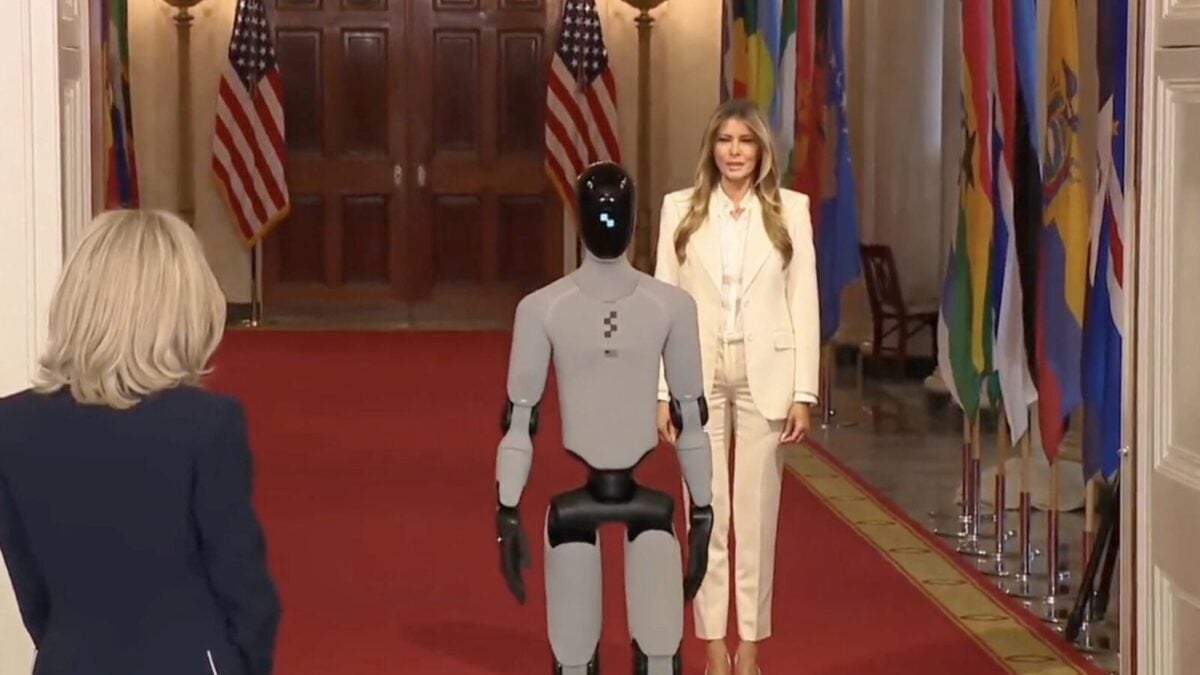
On March 25, 2026, Brett Adcock, CEO of Figure AI, took to social media to announce that his company’s F.03 concept robot had made history as the "first humanoid robot in the White House." This remark came during a two-day summit for First Lady Melania Trump’s "Fostering the Future Together" initiative, which aims to promote technology in education. The F.03 robot made an appearance, delivering brief remarks in multiple languages before departing in silence, prompting comparisons to past presidential encounters with robots.
But does this claim hold water? While Adcock’s announcement suggests a groundbreaking moment, it prompts questions about previous interactions involving humanoid robots and U.S. Presidents. For instance, in 2015, President Barack Obama interacted with disability advocate Alice Wong via a telepresence robot, a device that, while innovative, doesn't quite fit the definition of humanoid as it resembles a screen atop a wheeled base.
Another notable robot, Honda's Asimo, has met various world leaders, including Obama, but that encounter occurred in Tokyo, not the White House. Similarly, at the 2005 APEC summit, President George W. Bush encountered a peculiar humanoid robot named Albert HUBO, which featured an animatronic Albert Einstein head. However, this event also took place outside of the White House.
Some speculate that if a humanoid robot had ever entered the White House before Melania Trump's event, it could have been during Ronald Reagan's presidency. In 1987, Reagan was presented with a Tomy Omnibot 2000, a robotic toy, during a visit to Purdue University. This robot was later displayed at the Reagan Presidential Library, though it is a wheeled robot, which complicates its classification as humanoid.
This raises an interesting debate about the definition of humanoid robots. Some definitions encompass wheeled robots under the humanoid label, while others are stricter. Thus, while the F.03 may technically be the first humanoid robot to be formally recognized in the White House, it could be argued that Reagan’s Omnibot was there first, albeit not in a significant capacity.
The notion of a humanoid robot interacting with the White House is not entirely far-fetched. It’s conceivable that in the future, a president might formally welcome a robot into the Oval Office, marking a clearer milestone than the brief demonstration witnessed at the education summit.
Indeed, the current administration appears to have an increasing interest in robotics. In a recent press conference, President Trump discussed the need for robotic assistance in various sectors, emphasizing their role in workforce availability and industrial production. His remarks highlighted the potential for robots to aid in labor-intensive projects, suggesting a broader acceptance of robotic technology in everyday operations.
As for the F.03, its claim to be the first humanoid robot in the White House remains plausible yet unverified, as the White House Historical Association has yet to provide clarity on the matter. They were contacted for further insights, and updates will follow once a response is received.
This discussion about the F.03 underscores the evolving relationship between technology and governance, as society navigates the implications of integrating robots into daily functions and formal events. Whether or not the F.03 will be recognized as a historic milestone, its presence at the White House marks an intriguing chapter in the ongoing dialogue about technology's role in our lives.
Source:Gizmodo News