

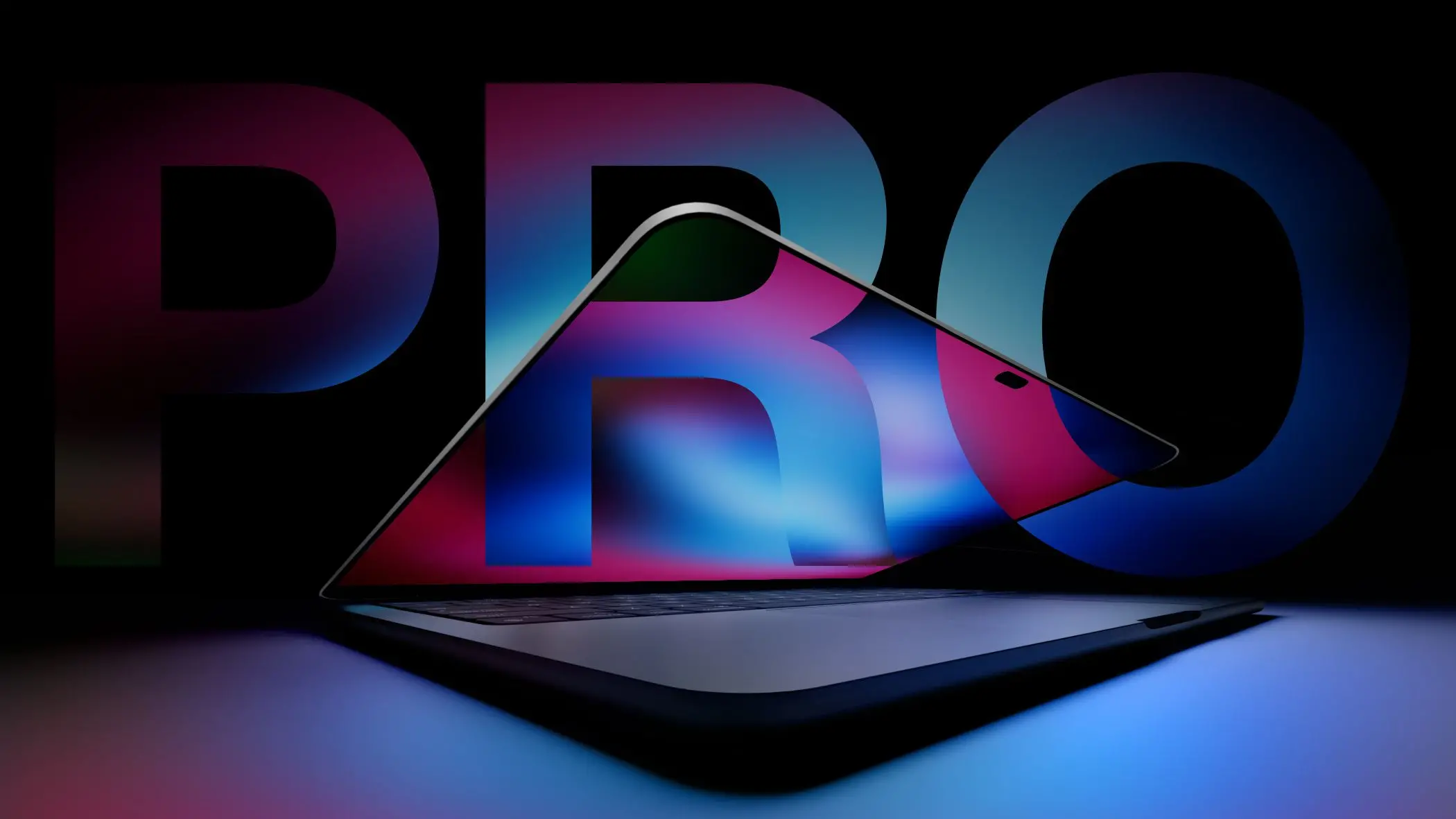
Apple is putting the finishing touches on a high-end MacBook Pro that is nearly ready for release, and the machine is set to deliver two long-awaited firsts for the company's laptop line: an OLED display and a touchscreen. The combination would mark the most significant change to the MacBook Pro since the debut of the M1 Pro and M1 Max models in 2021, and it arrives at a moment when Apple is simultaneously reworking its silicon roadmap and preparing its software for finger input.
Below are the key facts about the upcoming machine, followed by a closer examination of each area, from the chassis tweaks and panel technology to the chips inside and the price buyers should expect to pay.
Key Facts at a Glance
- Apple's first Mac with an OLED display, using rigid panels with oxide TFT backplanes and tandem OLED structures.
- Apple's first touchscreen Mac, with touch treated as a supplement to the trackpad and keyboard rather than a replacement.
- The notch is replaced by an iPhone-style Dynamic Island that takes up less display area.
- Two sizes: 14 inches and 16 inches.
- M5 Pro and M5 Max chips, because no M6 Pro or M6 Max is planned.
- The MacBook Pro name stays; the rumored MacBook Ultra branding is not happening.
- Pricing above current MacBook Pro models, which already rose by at least $300 in June 2026.
- Introduction on Wednesday, October 28, with availability possibly as soon as November 6.
Design
The MacBook Pro has not been redesigned since the 2021 launch of the M1 Pro and M1 Max machines, so the lineup is well overdue for a new look. The incoming model is expected to bring only minor design changes rather than a wholesale reinvention. There is a limit to how much can be altered within a laptop form factor, but reports point to a chassis that is lighter and possibly a bit thinner than the current generation, which implies internal structural tweaks and a revised casing.
The most visible change will be at the top of the display. Apple plans to eliminate the notch and replace it with an iPhone-style Dynamic Island. A Dynamic Island could better unify the way Siri AI behaves across the iPhone and the Mac, particularly with the pairing of iOS 27 and macOS Golden Gate, and it occupies less space on the panel than the current notch cutout. That matters more than usual on this machine, because a touchscreen benefits from an uninterrupted canvas and a smaller intrusion at the top edge.
There have been no credible reports of keyboard or trackpad changes, and neither component genuinely needs an overhaul. The Magic Keyboard and the large Force Touch trackpad remain among the best input devices on any laptop, so Apple appears content to carry them forward while adding a third, supplementary input method on the display itself.
Size Options
The OLED MacBook Pro will be offered in both 14-inch and 16-inch configurations, mirroring the current lineup. What remains unclear is positioning: Apple has not settled publicly on whether the new models will replace the existing mini-LED machines outright or be sold as a higher-end tier sitting alongside them. The distinction matters for buyers, because a parallel lineup would leave a more affordable mini-LED option in place for several years while the OLED version absorbs the premium.
Display
The centerpiece of the new machine is its OLED panel, the first in a Mac. OLED technology is already used across the iPhone, Apple Watch, and iPad Pro, but larger OLED screens have taken time to fall in price, which is why the MacBook Pro has stayed on mini-LED until now.
In most respects, OLED represents an upgrade over the current mini-LED implementation. Individual pixels switch off entirely rather than dimming, which produces true blacks, a dramatically higher contrast ratio, and far less blooming around bright objects on dark backgrounds. Colors are richer, and HDR performance generally exceeds what mini-LED can deliver. The tradeoff is brightness: OLED panels sometimes cannot match the peak brightness levels of mini-LED, particularly during sustained full-screen highlights.
Reports indicate that Apple is using rigid OLED panels paired with oxide TFT backplanes and advanced tandem OLED structures. Tandem OLED stacks two emitting layers to boost brightness and longevity, and the approach is already proven in the iPad Pro, where it delivers a longer lifespan with less risk of burn-in than single-stack OLED panels. Burn-in resistance is especially important on a computer, where static interface elements such as the menu bar and dock remain on screen for hours at a time.
Touchscreen
Alongside OLED, the MacBook Pro is expected to be the first Mac with a touchscreen. Users will be able to interact with the display directly, much as they would on an iPad.
Critically, touch capabilities will be used alongside the trackpad and keyboard rather than in place of them, which suggests Apple views finger input as supplementary rather than as a primary control method. The company is reportedly adapting macOS Golden Gate for touch, and it plans to add a reinforced hinge to the display assembly so that the panel does not wobble when it is tapped. That hinge detail is a telling one: it acknowledges that a laptop screen is a sprung, hinged object, not a rigid tablet, and that pushing on it produces movement unless the mechanism is stiffened.
Touchscreen Hints in macOS 27
Several features in macOS Golden Gate point toward a future touchscreen Mac. Apple added direct touch input to Sidecar, allowing users to tap and interact with macOS elements when an iPad is used as a Mac display. That groundwork matters, because it establishes a system-level way for macOS to interpret direct taps rather than relying on a cursor proxy.
The software also supports an iPhone-style pull-to-refresh gesture, usable across apps including Safari, Mail, News, Podcasts, and Calendar. Pull-to-refresh only truly makes sense on a touch display, where dragging a list downward is the natural way to request new content. Taken together, these additions look less like isolated conveniences and more like the early scaffolding for a touch-first interaction layer that will be fully exposed on the new hardware.
Chips
The current high-end MacBook Pro models run on M5 Pro and M5 Max chips, and Apple intends to use the same silicon in the OLED MacBook Pro. That decision is driven by an unusual gap in the roadmap. Apple has already introduced an M6 chip in the latest Mac mini, and it is expected to appear in a low-end MacBook Pro and an iMac on October 28, but there is reportedly no plan to release M6 Pro or M6 Max variants.
Apple's chip plans changed earlier this year, and the company is now accelerating the launch of the M7 series, which features major neural-processing improvements aimed at meeting demand for machines that can handle AI workloads locally. Because no M6 Pro or M6 Max exists, Apple must use the M5 Pro and M5 Max to avoid delaying the OLED MacBook Pro until the M7 generation is ready. A second-generation OLED MacBook Pro, planned for late 2027, will move to M7 Pro and M7 Max chips.
The practical effect is a machine whose processor generation trails the entry-level M6 hardware arriving the same week, an unusual inversion for a flagship laptop. Buyers will be paying for the display and the touch experience rather than for the newest core architecture, and the M5 Pro and M5 Max remain highly capable parts with strong GPU and media engine performance.
Naming
There had been rumors that the OLED model would be branded the MacBook Ultra, but that is apparently not happening. The product unveiling carries the tagline Pro and tell, making it clear the new device will retain the Pro name. The abandoned Ultra label follows a similar pattern elsewhere in Apple's lineup, where a long-rumored Ultra-branded iPhone ultimately shipped under a different name entirely.
Pricing
The OLED MacBook Pro is expected to be a premium product, with a price tag above current MacBook Pro models. Apple raised prices across the entire Mac line in June 2026, so the new machine could be even more expensive than the already elevated rates. MacBook Pro pricing increased by a minimum of $300 as part of those June hikes.
For context, the higher-end 14-inch MacBook Pro with an M5 Pro chip now starts at $2,499, while the 16-inch M5 Pro model starts at $2,999. The M5 Max configurations begin at $4,099 for the 14-inch and $4,399 for the 16-inch. Adding an OLED panel and a touchscreen on top of that baseline points to a starting price that could comfortably exceed $3,000 for the smaller model.
Launch Date
Apple will introduce new Macs on Wednesday, October 28, as part of a Pro and tell launch. There will be no livestreamed event; instead, selected members of the media have been invited to Los Angeles for an all-day product launch experience to try the new devices in person. The OLED MacBook Pro could launch as soon as November 6, putting it on shelves roughly a week after it is announced and positioning it firmly in the holiday shopping window.
Source:MacRumors News