

Cisco and Nvidia take aim at Ethernet AI fabric bottlenecks
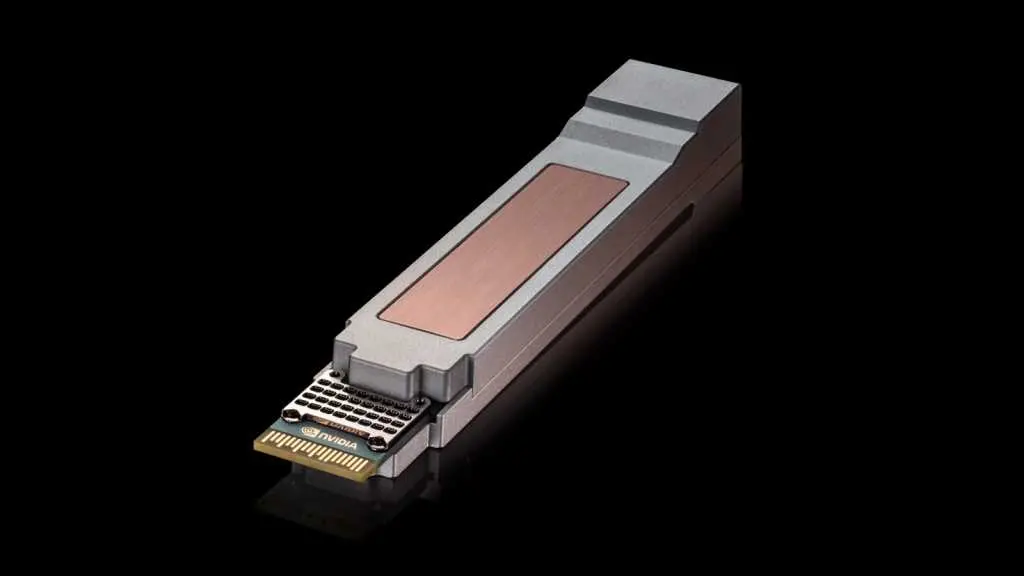
Cisco and Nvidia have introduced a high-capacity pluggable optical system intended to make it faster and easier for customers to build Ethernet fabrics for artificial intelligence workloads. The product, called the Ultra-Dense Small Form Factor Pluggable module, or USFP, was announced at the Open Compute Project Global Summit 2026. It is designed to address the mounting pressure that AI infrastructure places on the links between GPUs, switches, security appliances, and other systems in modern data centers.
The companies said USFP supports 400 Gb/s per lane electrical signals and can provide up to 12.8 Tb/s of aggregate capacity for infrastructure that spans networking, security, AI systems, and high-performance AI fabrics. The goal is to let operators increase bandwidth density without increasing the footprint of connectivity hardware at the same rate. That matters as AI clusters grow larger and as more compute capacity is packed into each rack.
Key facts at a glance
- Cisco and Nvidia unveiled USFP at the OCP Global Summit 2026.
- The module supports 400 Gb/s per lane electrical signaling.
- A 16-lane configuration delivers 6.4 Tb/s of aggregate capacity, four times the bandwidth density of current 1.6T pluggables.
- The architecture can scale to 32 lanes and 12.8 Tb/s of aggregate capacity.
- The design offers a path to roughly 1.3 times greater power efficiency through 400G SerDes technology.
- USFP is intended to support both 200G and 400G SerDes-based systems and ASICs.
- The modules remain field-replaceable and are meant to preserve familiar deployment and maintenance practices.
- Cisco and Nvidia plan to create an open industry specification through a community-led multi-source project.
- The USFP work is not considered part of the existing Cisco-Nvidia partnership.
- Cisco also expanded its Silicon One portfolio with the G302 top-of-rack switching chip.
Bandwidth density has become a central design constraint for AI factories. Training and inference workloads generate massive amounts of east-west traffic as accelerators exchange data with one another, with storage, and with the broader network. When a switch reaches its capacity, adding more network capacity can require additional switch layers and optical links. Those extra layers can increase latency, power consumption, and cost, while also complicating operations. Cisco and Nvidia argue that USFP can help customers scale from today's 1.6T fabrics to higher-capacity designs while keeping the pluggable optics model that data centers already know.
The technical approach centers on higher-speed SerDes and a denser pluggable form factor. SerDes, or serializer/deserializer, technology converts parallel data into serial signals for transmission and back again. Moving from 200 Gb/s per lane to 400 Gb/s per lane doubles the signaling rate per lane, which can reduce the number of lanes needed for a given amount of bandwidth or increase total capacity within the same module footprint. According to Cisco and Nvidia, USFP can support 16 lanes at 400 Gb/s per lane for 6.4 Tb/s of aggregate capacity. That is four times the bandwidth density of today's 1.6T pluggables, the companies said. The architecture can then scale to 32 lanes, providing a path to 12.8 Tb/s.
Power and cooling are equally important. AI data centers are already straining power budgets and thermal limits, and every additional optical link adds to both. Cisco and Nvidia said USFP creates an opportunity for approximately 1.3 times greater power efficiency by using 400G SerDes technology. That improvement may not sound dramatic on a per-module basis, but at the scale of a large AI cluster, even modest gains in power per bit can affect rack design, cooling capacity, and overall operating costs. The companies also emphasized that USFP preserves serviceability. The modules can be replaced in the field, and customers can continue using familiar deployment and maintenance practices rather than moving to a sealed or less accessible optical architecture.
That serviceability point is significant. Pluggable optics have long been valued in data centers because they allow operators to swap failed or outdated components without replacing an entire switch or line card. As AI fabrics become denser and more expensive, the ability to maintain and upgrade optics in place can reduce downtime and extend the life of networking equipment. Cisco and Nvidia said USFP combines a path to higher-capacity fabrics and improved efficiency with familiar operational practices, helping customers scale AI infrastructure while maintaining flexibility, interoperability, and consistency.
Nvidia framed the announcement in terms of the broader challenge of scaling AI factories. The company said scaling AI factories requires more bandwidth per connection and more connections per switch. When a switch reaches capacity, further network expansion can require additional switch layers and optical links, which increases latency, power consumption, and costs. USFP is designed to let AI factory builders scale from 200 Gb/s per lane to 400 Gb/s per lane Ethernet AI fabrics while extending a deployment model that has been proven at scale across multiple generations of data center networks. Nvidia added that customers can adopt next-generation optical technology and meet the performance demands of AI workloads without overhauling their data center infrastructure.
The partnership angle is nuanced. Cisco and Nvidia have collaborated closely over the past year on Spectrum X technology, including switch silicon and related networking capabilities. However, Nvidia marketing director Brian Sparks said during a pre-briefing that USFP is not part of that partnership. Instead, he described it as Cisco, Nvidia, and others in the ecosystem believing that USFP is the right solution moving forward. The distinction matters because it shows that the USFP effort is broader than a single bilateral product agreement. Cisco and Nvidia plan to create an open industry specification for USFP through an upcoming community-led multi-source project. A multi-source approach could encourage multiple vendors to build compatible modules, which may help customers avoid lock-in and accelerate adoption.
Open specifications have become increasingly important in networking, especially as AI infrastructure evolves quickly. Customers want to mix components from different vendors and avoid rebuilding their operational models for every new generation of hardware. An open USFP specification could allow optics vendors, switch vendors, and hyperscalers to align on mechanical, electrical, and management interfaces. That alignment could reduce integration risk and make it easier to source modules from multiple suppliers. It could also help the industry move faster from early designs to volume deployment.
Silicon One G302 extends the rack-level switching roadmap
In addition to USFP, Cisco announced an expansion of its Silicon One portfolio with the G302, a 51.2-terabit-per-second top-of-rack Ethernet switching chip aimed at high-density AI and cloud data center networks. The G302 delivers 102.4 Tb/s of capacity and features Cisco 1.6T optics and direct-to-chip liquid cooling integration. Cisco said the chip will typically sit at the rack level, gathering traffic from servers and connecting the switch efficiently to the larger data center network.
The G302 is an expansion of the 102.4 Tb/s Silicon One G300 portfolio, which Cisco said is shipping now. The G300 family includes Intelligent Collective Networking, a set of capabilities that supports shared packet buffers, path-based load balancing, and proactive network telemetry. Those features are designed to handle large-scale, bursty data center traffic, AI training, inference, and real-time agentic workloads. Cisco said the G302 is at the heart of two new fixed-form 64-port switches: the 3RU air-cooled 8133 and the 2RU 8132, which is Cisco's first commercially available water-cooled switch.
The switch announcements highlight how AI networking is changing system design at the rack level. Higher radix switches can reduce the number of tiers in a network, which can lower latency and simplify cabling. Liquid cooling is becoming more common as power densities rise, and direct-to-chip cooling integration can help operators manage thermal loads more efficiently. The combination of higher-capacity switching silicon, denser optics, and advanced cooling is aimed at the same underlying problem: moving more data between accelerators without letting the network become the bottleneck.
Cisco said the G302 is planned to begin shipping to customers before the end of 2026. The USFP effort and the G302 expansion together show how vendors are attacking AI fabric constraints from multiple directions, including optical density, SerDes speed, switch capacity, and cooling. The industry is watching whether open specifications and multi-vendor ecosystems can keep pace with the rapid cadence of AI hardware. For now, the companies have laid out a roadmap that combines higher bandwidth per lane, denser pluggables, and rack-level switching designed for the power and thermal realities of AI data centers.
Source:Network World News