

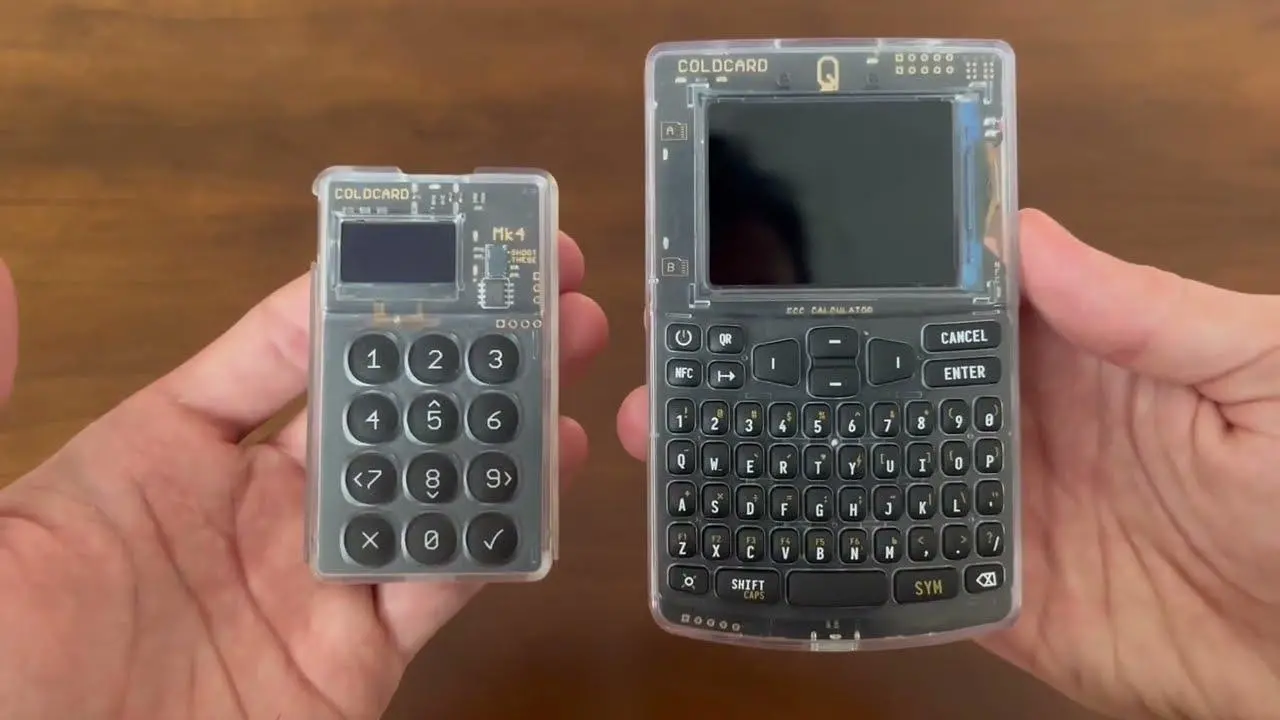
More than $70 million in bitcoin disappeared from supposedly secure hardware wallets last week in a theft that never required physical access to the devices. The heist targeted Coldcard users, and newly published research from Galaxy Research indicates that the root cause was not a compromised device, but rather a flaw in the way certain wallets generated the random seed phrases that underpin private keys.
A 41-minute sweep
According to Galaxy Research, more than 1,000 bitcoin, worth roughly $70 million at the time, were drained from 1,196 Coldcard wallets in a 41-minute span on July 30. The number of affected wallets is nearly double the loss first reported by independent security trackers. What makes the case particularly alarming is that the attacker never touched a single device. Instead, the thief recreated likely private keys offline, swept the balances, and then kept searching for more vulnerable wallets even after the first wave of thefts was detected.
The attack was not a conventional malware intrusion. No phishing emails, no malicious USB cables, no tampered firmware were required to reach the victims. For users who had been told that cold wallets were immune to remote theft, the implications are severe. A hardware wallet is only as secure as the randomness used to create its seed phrase, and in this case, that randomness was apparently flawed.
Key findings at a glance
- More than 1,000 BTC, worth about $70 million, were drained from 1,196 Coldcard wallets on July 30.
- The theft took place in a 41-minute window and reached nearly double the initially reported loss.
- Galaxy Research says the attacker recreated likely private keys offline using weak seed generation.
- The attacker never physically accessed any of the affected devices and continued searching after the first sweep.
How cold wallets work
Cold wallets are meant to keep bitcoin private keys offline, away from internet-connected devices where they can be stolen by hackers. A hardware wallet like the Coldcard is a small dedicated device that can generate a seed phrase, usually 12 or 24 words, using a random number generator. That seed phrase is the master key to a user’s bitcoin. Anyone who possesses the seed can reconstruct the private keys and spend the funds, regardless of whether they have the physical device.
In theory, the seed phrase should be generated from enough cryptographic entropy to make guessing impossible. The industry standard, BIP39, uses a 128-bit or 256-bit entropy source. If a device produces seed phrases with low entropy, the number of possible seed combinations shrinks drastically. An attacker with enough computing power can enumerate the candidates and check each one against the bitcoin blockchain for balances.
What went wrong
Galaxy Research’s initial assessment points to a firmware flaw in certain Coldcard hardware wallets. Under some conditions, the random number generator inside the device may not have produced true randomness. Instead, the seed phrases were computationally enumerable, meaning an attacker could reconstruct likely private keys without ever seeing the device or its backup.
Weak seed generation is one of the oldest problems in cryptocurrency security, but it has rarely been observed at this scale. The attacker likely generated a large set of candidate seeds, derived their corresponding addresses, and filtered for wallets with funds. This technique requires no interaction with the victims and can be repeated indefinitely. The research suggests the attacker used this approach to sweep more than 1,000 BTC and is probably still running the same search against newly generated addresses.
No easy way to know
Security firms are warning that more wallets could be hit because owners cannot reliably determine whether their seed phrases were generated on vulnerable firmware. A Coldcard bought years ago may have been updated many times since, and old log files or backups do not necessarily reveal the generator state at the moment the seed was created. Even a device that appears healthy today may have been affected by flawed code during an earlier firmware version.
The uncertainty has created panic among Coldcard users. On-chain data shows that many users have already moved their funds to other wallets, but a significant number of wallets are still holding balances. The Coldcard manufacturer, Coinkite, has urged users to move bitcoin to new wallets as the exploit is still in progress. The company has not yet released an official statement explaining the exact firmware versions affected, leaving users to guess.
An attacker with a public face
In a strange twist, the attacker’s bitcoin wallet has become a public spectacle. The wallet address, which was used to consolidate the stolen funds, has received a flood of messages from internet users. Some are pleading for the return of lost funds, while others are trying to hustle the thief with fake recovery services or jokes. Blockchain memos embedded in transactions have turned the wallet into a kind of graffiti wall, but the attacker has not responded and continues to hold the bulk of the stolen bitcoin.
Investigators are not entirely in the dark. According to the research, the attacker has been traced through logs from a blockchain data provider that recorded queries related to the swept addresses. These logs may reveal the attacker’s IP address, timing patterns, and other metadata. However, tracing a sophisticated crypto thief across borders is a slow process, and it is unclear whether the funds can be recovered.
Who is responsible
Galaxy Research identified the vulnerability as a seed-generation flaw, but the exact source of the weak randomness has not been fully disclosed. Some independent security engineers have suggested that the issue may lie in a specific random number generator implementation used by older Coldcard firmware. Others have noted that hardware random number generators are difficult to test because they depend on physical variations in silicon.
This is not the first time weak randomness has led to bitcoin theft. In the early years of bitcoin, a number of mobile wallets and web services generated private keys with insufficient entropy, allowing attackers to sweep funds from addresses at will. More recently, some blockchain projects have suffered from similar weaknesses in key generation libraries. But the Coldcard incident is notable because it undermines the central promise of hardware wallets: that they provide a secure enclave for private keys.
What users should do now
Until the affected firmware versions are identified, the safest course is to assume that any Coldcard wallet may be vulnerable. That means moving funds to a new wallet created with a different device or with a trustworthy software wallet that uses a verified random number generator. Users should not simply update the firmware and reuse the same seed, because the seed itself may have been created with weak entropy.
For new wallets, experts recommend using an independent source of randomness. Some hardware wallets allow users to supply their own entropy through dice rolls or other physical sources. This can eliminate the risk of a firmware-generated seed being predictable. Users should also avoid relying solely on a manufacturer’s random number generator, no matter how well regarded the device.
Another recommended step is to diversify storage. Instead of keeping all bitcoin in one wallet, users can split funds across multiple wallets and multiple hardware devices. This reduces the impact of a single vulnerability. It is also wise to monitor blockchain addresses regularly so that unusual activity can be detected early.
Broader implications
The attack has sent shockwaves through the cryptocurrency industry because it shows that even cold wallet users are not safe from remote attacks. The phrase 'not your keys, not your coins' has long been a rallying cry for self-custody, but incidents like this expose the limits of self-custody when the key generation process is flawed. A hardware wallet cannot protect users from its own internal errors.
The event also highlights the importance of cryptographic transparency. Hardware wallet vendors must publish detailed information about their random number generation processes and allow independent audits. Without that, users have no way to assess the security of the device beyond trust in the brand.
For now, the most urgent step is to move any bitcoin that may have been created on affected hardware to a newly generated wallet, using a source of randomness that cannot be silently weakened by firmware. Until that uncertainty is resolved, even the coldest storage cannot be considered safe.
Source:Coindesk News