

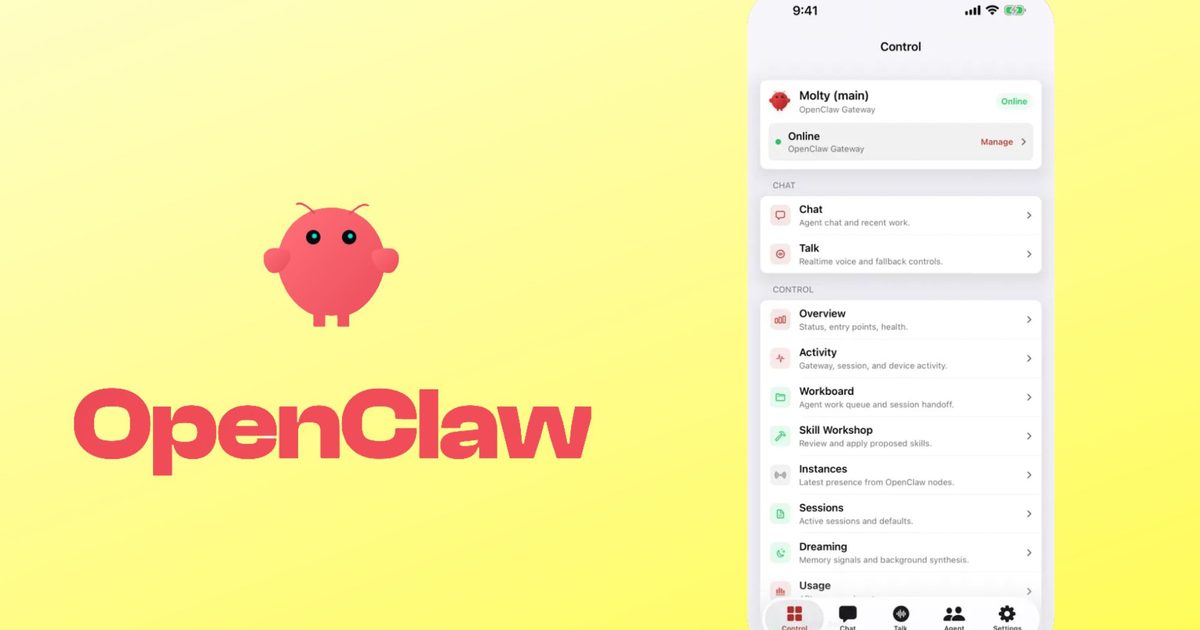
The open-source AI agent OpenClaw has officially launched native mobile applications for both iOS and Android, bringing its privacy-focused, self-hosted AI capabilities to users' fingertips. Unlike closed ecosystems such as ChatGPT or Gemini, OpenClaw runs entirely on your own hardware—be it a Mac, PC, or Linux machine—and now pairs seamlessly with a smartphone via a secure gateway. This development marks a significant step toward democratizing AI control, allowing users to interact with their agent on the go without sacrificing data ownership.
How OpenClaw Works on Your Phone
Setting up the mobile app is straightforward. After installing OpenClaw's gateway software on a personal computer, users simply scan a QR code or enter a setup code on their phone to establish an encrypted connection. The entire process takes just a few minutes. Once paired, the phone becomes a remote terminal for the AI agent, enabling direct text-based chat or a real-time Talk mode for voice conversations. Every action the agent intends to take on the gateway—whether executing a command, accessing a file, or triggering a workflow—first requires explicit user approval. This manual oversight is a cornerstone of OpenClaw's security philosophy, ensuring that the AI never acts autonomously without consent.
The app also supports sharing text, links, and media directly from the phone into the agent's context. Users can selectively grant or deny access to device features such as the camera, screen location, photos, contacts, calendar, and reminders. Push notifications keep users informed of workflow completions or pending actions even when the app runs in the background. This level of integration positions OpenClaw as a practical tool for power users who want to automate tasks across their personal computing ecosystem while maintaining complete transparency.
Open Source Advantage and Privacy
What truly differentiates OpenClaw from mainstream AI assistants is its open-source nature. Anyone can inspect the source code, verify security measures, and customize the agent to meet specific needs. This contrasts sharply with proprietary alternatives like ChatGPT or Google's Gemini, where backend operations remain opaque. For privacy-conscious users, running the gateway on local hardware means that no conversation data, file access, or personal information is ever transmitted to third-party servers. The mobile apps simply act as a secure relay, not a data collector. OpenClaw's design aligns with growing demand for transparent AI systems, especially in an era where data breaches and surveillance concerns are increasingly common.
The open-source community has embraced OpenClaw, contributing to its rapid development. Since its initial desktop release, the project has gained thousands of GitHub stars and active contributors. The mobile apps have been highly anticipated, as they extend the agent's utility to portable devices without compromising the core promise of local control. Developers have already started building custom integrations, from home automation triggers to code compilation assistants, all routed through the same gateway.
iOS vs Android: A Tale of Two Versions
While both apps share the same underlying functionality, early user reviews suggest noticeable differences in polish. The iOS version requires iOS 18 or later and is listed as a Productivity app that collects no user data, according to its App Store listing. It is completely free to download and use. Reviewers describe the iOS interface as sleek and refined, with smooth animations and intuitive navigation. The talk mode in particular benefits from Apple's robust audio processing and push notification infrastructure.
In contrast, the Android version demands Android 12 or higher and has been described as rough around the edges. Some users report that the user interface feels unfinished, with occasional layout quirks and less responsive touch targets. However, power users appreciate that the Android app still delivers the core features: gateway pairing, chat, voice, and notification support. The disparity in polish likely stems from the team's smaller focus on Android during initial development, though the developers have promised ongoing improvements on both platforms.
Industry Implications and Competition
OpenClaw's growing popularity has not gone unnoticed by tech giants. Reports indicate that Google is actively developing its own 24/7 personal agent intended to compete directly with OpenClaw. While details remain scarce, Google's move suggests a recognition that open-source, locally-run AI agents could pose a threat to subscription-based, cloud-dependent services. The ability to own and control one's AI agent is a powerful proposition that resonates with a broad audience, from developers to digital rights advocates.
Beyond the immediate novelty, OpenClaw represents a shift toward agentic AI—systems that can perform multi-step tasks autonomously under human supervision. The approval-based architecture reduces the risk of unintended actions, making it suitable for sensitive operations like file management, email drafting, or smart home control. As the ecosystem matures, more users are expected to adopt the gateway model, effectively turning their personal computers into secure AI servers accessible from anywhere via their smartphones.
For newcomers, the barrier to entry remains moderate: they need a always-on computer capable of running the gateway software, which can be as modest as a Raspberry Pi or an old laptop. The mobile apps lower the friction for daily interaction, making OpenClaw a viable alternative to cloud-based assistants for those who prioritize privacy, customization, and control. As development continues, the gap between iOS and Android polish is likely to narrow, and the feature set will only expand.
The launch of these mobile apps also highlights a broader trend in the AI landscape: the move away from purely cloud-centric models toward hybrid or on-device processing. While large language models still require significant computational resources, techniques like quantization and model distillation are making it feasible to run smaller but effective agents locally. OpenClaw's modular design allows users to plug in different models, from Llama to Mistral, giving them freedom to choose the best engine for their tasks.
In summary, OpenClaw's arrival on iOS and Android is more than just a port—it's a strategic expansion of the open-source AI ecosystem. By putting a secure, user-controlled agent in everyone's pocket, the project challenges the dominant paradigm of closed, subscription-based AI assistants. Whether the app will achieve mass adoption remains to be seen, but for enthusiasts and professionals who value data sovereignty, it's already a compelling option. And with Google reportedly stepping into the arena, the competition promises to accelerate innovation in the personal AI space.
Source:Digital Trends News